The Story
Patricia knew the article was good before anyone else read it.
That did not happen often.
Usually, finishing a piece of writing only started a second round of questions in her head. She would reread the same sentence until it stopped sounding like language. She would replace simple words with more formal ones, then replace them back. She would wonder whether a phrase sounded natural, whether the tone was too direct, whether the sentence structure gave away the fact that English was not her first language.
This time felt different.
The article was personal.
It was about learning to write in English while working with people from different countries. Patricia had written about small misunderstandings, the pressure to sound professional, and the strange moment when a sentence could be grammatically correct but still feel wrong to a reader.
She had even written about Tonebug and the lesson she had learned from one short email.
The final paragraph was her favorite:
Writing clearly does not mean becoming a different person. I want my English to improve, but I still want the words to feel like mine.
Patricia read the sentence once more.
She did not change it.
That alone felt like progress.
Draft sat near the edge of her laptop, quietly sorting a stack of notes. Mr. Red Pen was asleep on top of a closed dictionary, his glasses slightly crooked.
Patricia saved the document.
“Finished,” she said.
Draft looked up.
“Actually finished?”
“Yes.”
“No last-minute rewriting?”
“No.”
“No replacing normal words with words you found in a thesaurus?”
Patricia gave him a look.
“That happened once.”
“Four times.”
“Finished,” Patricia repeated.
Draft smiled.
The article was meant for a small professional writing community. One of its editors had invited Patricia to contribute after reading some of her earlier work.
There was only one part she was nervous about.
The editor had told her that another writer would review the article before publication.
His name was Scribe.
Patricia had heard of him.
Almost everyone in that writing group had.
Scribe was known for clean prose, sharp opinions, and comments that could reduce an entire paragraph to a single sentence.
People admired him.
People argued with him.
People sometimes did both at the same time.
Paige had once described him as “the kind of person who could make a grocery list sound like a final exam.”
Patricia had laughed then.
She was not laughing now.
A notification appeared on the laptop.
Review comments received.
Patricia's hand stopped above the mouse.
Draft noticed.
“You don't have to open them immediately.”
“I know.”
She opened them immediately.
The first paragraph had three comments.
The second had five.
By the time she reached the middle of the article, the right side of the document was full.
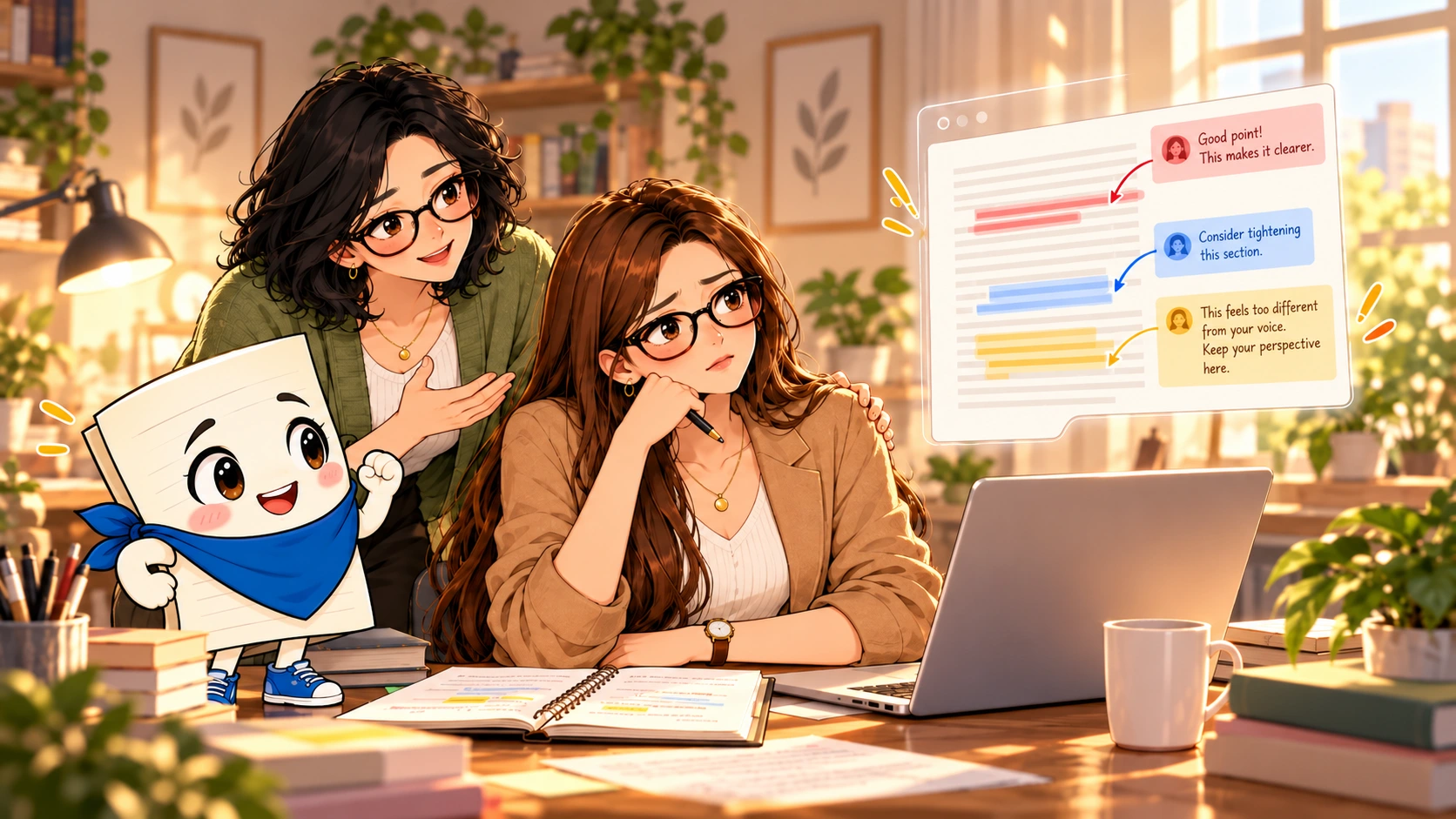
Some comments were small.
Good point. Tighten this sentence.
Clearer if you move this earlier.
This example works.
Others were less gentle.
Awkward.
Not natural.
A native speaker would probably phrase this differently.
Patricia's stomach tightened.
Then she reached a sentence she liked.
I used to think every mistake in English meant I was not ready to call myself a writer.
Beside it, Scribe had written:
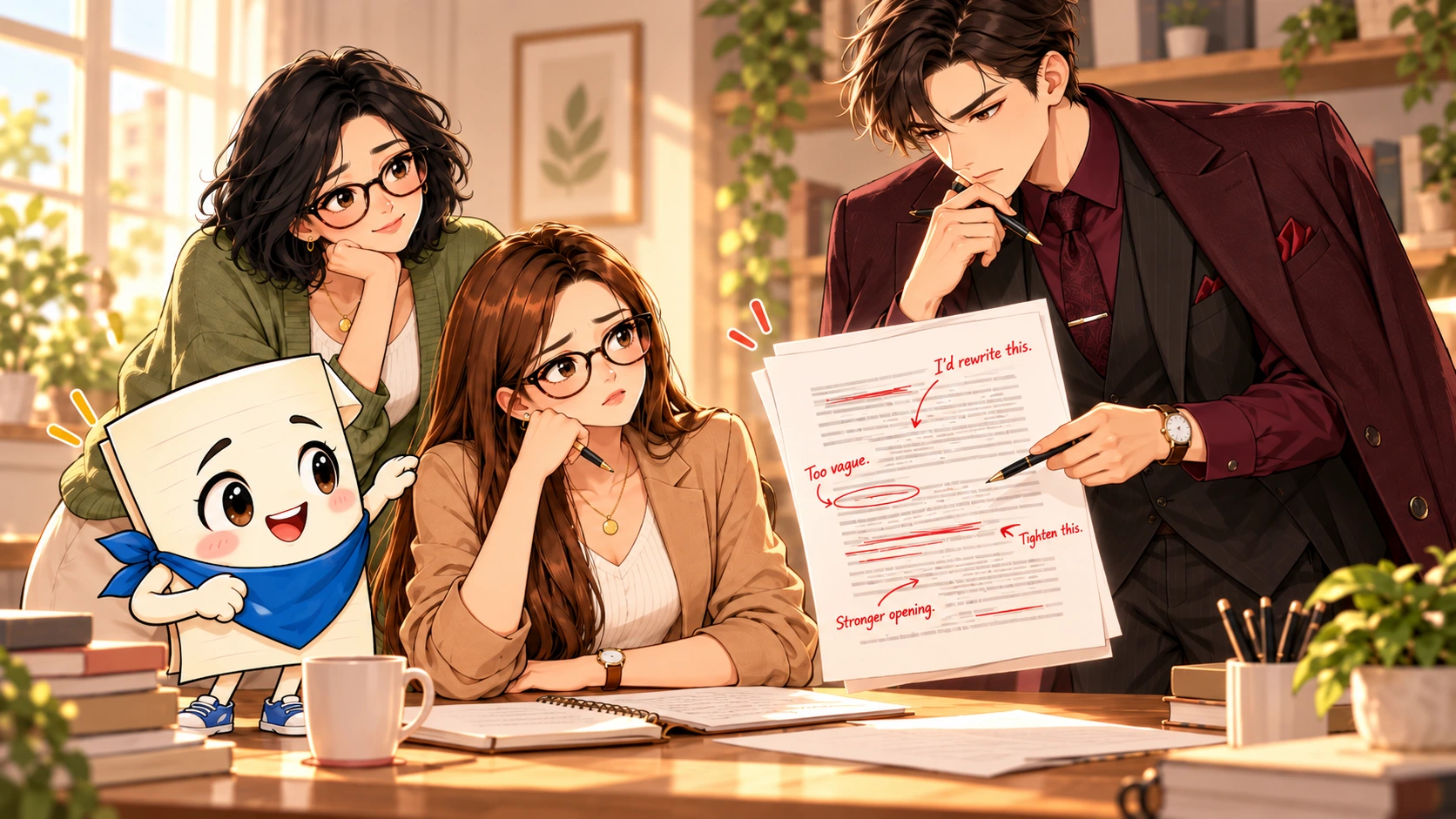
I'd rewrite it.
Patricia stared at the comment.
No explanation.
No suggestion.
Just four words.
She scrolled farther.
Another paragraph.
I'd rewrite this.
Another.
This sounds non-native.
Another.
Technically correct, but I would not say it this way.
Patricia stopped scrolling.
The confidence she had felt ten minutes earlier had disappeared so quietly that she had not noticed it leaving.
Draft moved closer to the screen.
“He left a lot of comments.”
Patricia nodded.
Mr. Red Pen woke up.
“Comments?”
He jumped to his feet.
“Errors?”
“Not exactly,” Draft said.
Mr. Red Pen hurried toward the laptop anyway.
Patricia returned to the first page.
She read her article again, but now she could see Scribe's comments even when they were not on the screen.
Awkward.
Non-native.
I'd rewrite it.
The sentences that had felt personal that morning suddenly looked suspicious.
Patricia placed both hands on the keyboard.
“All right,” she said quietly.
Draft looked at her.
“What are you doing?”
“Fixing it.”
The First Rewrite
At first, Patricia changed only the sentences Scribe had marked.
She removed a phrase that he called awkward.
She shortened another sentence.
She replaced a simple expression with one of his suggested alternatives.
Some changes genuinely improved the article.
One paragraph had been too long. Patricia could see that now.
A transition really had been unclear.
One example made more sense after she moved it.
Those edits felt useful.
Then she reached the comments about what sounded “native.”
Patricia hesitated.
The original sentence read:
Sometimes I know what I mean, but I need a little more time to find the clearest way to say it.
Scribe's suggestion:
Sometimes my intended meaning is clear to me before I determine the most precise phrasing.
Patricia read his version.
It was polished.
It was correct.
It also sounded nothing like her.
She left the cursor at the end of the sentence.
Draft climbed onto the keyboard.
“Do you like it?”
“It sounds professional.”
“That wasn't my question.”
Patricia reread the sentence.
“I don't know.”
She changed it anyway.
The next suggestion was smoother.
The one after that sounded more sophisticated.
Soon Patricia stopped comparing the changes to her own intentions. If Scribe had marked something, she assumed he had noticed a problem she was not experienced enough to see.
Mr. Red Pen followed along happily.
“Excellent. Cleaner. Stronger. More formal.”
Draft did not join in.
By late afternoon, Patricia had rewritten nearly half the article.
She leaned back and rubbed her eyes.
The page looked impressive.
The sentences were controlled.
The vocabulary was polished.
Nothing seemed obviously wrong.
And yet Patricia felt no satisfaction when she read it.
The article had begun with a memory of her first professional email in English. In the original version, she had written:
I checked that email so many times that I almost missed the deadline for sending it.
Now it read:
I repeatedly reviewed the message to ensure accuracy before submission.
Patricia stared at the sentence.
The second version was shorter.
More formal.
More professional.
It was also strangely empty.
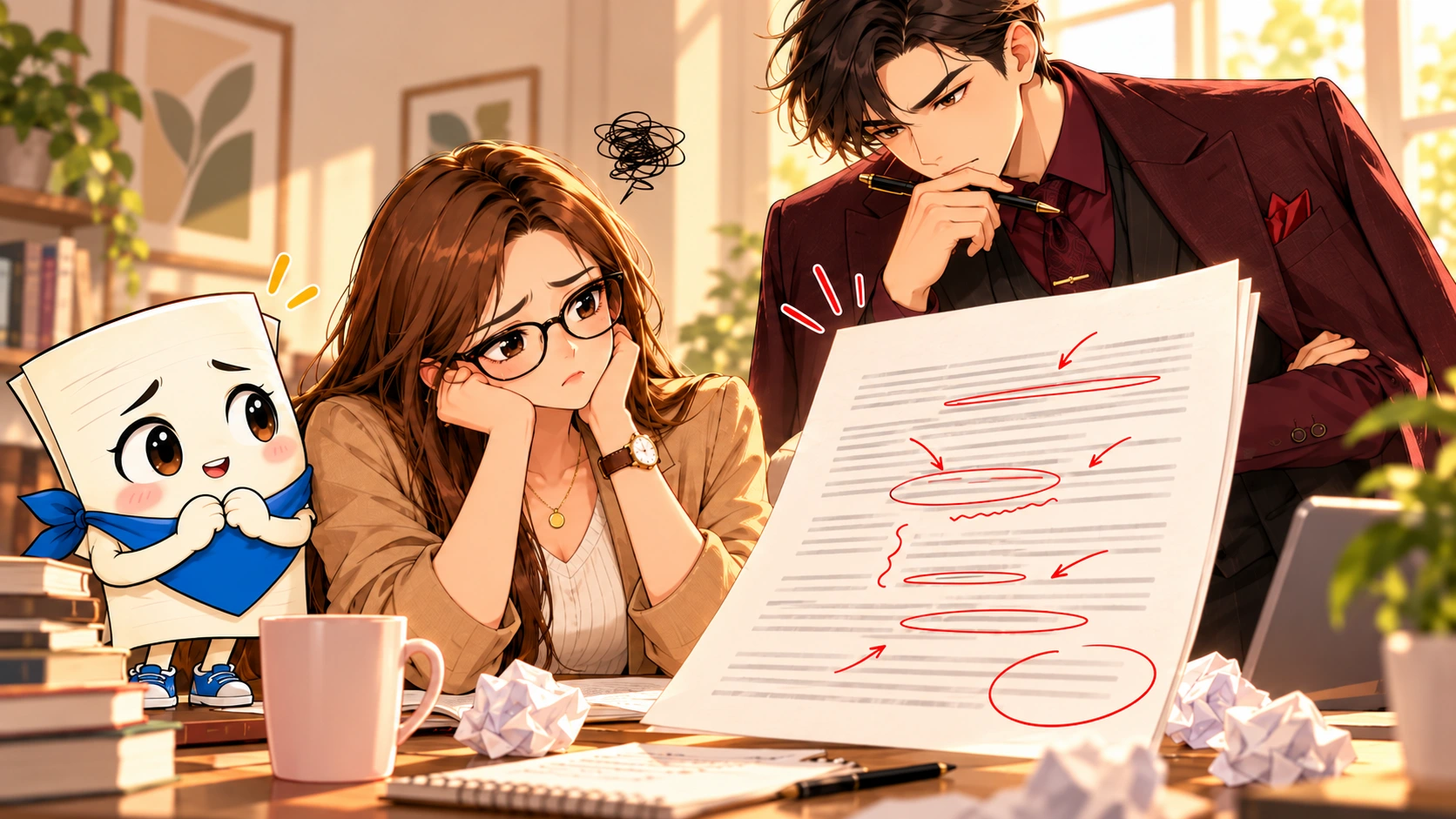
Draft pointed toward it.
“What happened in the original memory?”
“I checked the email too many times.”
“And how did you feel?”
“Nervous.”
“Can you feel that in this version?”
Patricia did not answer.
Draft looked at another paragraph.
“What about this one?”
Patricia read it silently.
The information was still there.
But the small pieces of Patricia had disappeared.
Her humor.
Her hesitation.
The way she described ordinary situations.
Even the sentences she had been proud of now sounded as though they belonged to someone writing from a much cleaner, colder room.
A message appeared on her phone.
Paige.
Coffee?
Patricia looked at the article.
“Yes,” she said.
Draft glanced at her.
“To Paige?”
“To getting away from this screen.”
The Second Reader
The café was warm and crowded enough that Patricia had to wait several minutes for a table.
Paige arrived carrying a canvas tote bag and two books she had promised to return weeks ago.
Her short black hair had been pushed behind one ear, and her black round glasses fogged slightly when she stepped in from the cooler air.
She sat across from Patricia.
“You look like someone rejected your passport application.”
Patricia laughed despite herself.
“It feels worse.”
“That serious?”
Patricia turned the laptop around.
“I wrote an article. Someone reviewed it.”
Paige read the title.
“Was the article bad?”
“I thought it was good.”
“That wasn't my question.”
Patricia paused.
“No. I don't think it was bad.”
“Then what happened?”
Patricia explained the review.
Not every comment.
Just enough.
She told Paige about Scribe's reputation, the repeated notes about sounding non-native, and the growing feeling that every unusual sentence might be proof that her English was not good enough.
Paige listened without interrupting.
When Patricia finished, she pushed the laptop toward her.
“Which version do you want me to read?”
Patricia opened the original article in one tab and the revised version in another.
“The new one first.”
Paige began reading.
Patricia watched her face.
Paige was not an editor. That was exactly why Patricia trusted her.
She did not look for perfect punctuation or advanced vocabulary. She reacted like a normal reader.
She smiled when something was funny.
She frowned when something was unclear.
She asked questions when a sentence made her stop.
Today, she mostly read in silence.
When she finished, she leaned back.
“Well?”
Paige looked at Patricia.
“It sounds good.”
Patricia waited.
Paige knew that look.
“But?”
Paige turned the laptop back around.
“It sounds like one of those articles I read and forget five minutes later.”
Patricia winced.
“That bad?”
“No. That's the problem. It's not bad.”
Paige opened the original.
She began reading again.
This time she smiled in the first paragraph.
Halfway down the page, she laughed.
When she reached the story about Patricia nearly missing the email deadline because she kept checking her grammar, Paige pointed at the screen.
“That is very you.”
Patricia looked at the sentence.
The old sentence.
The one she had replaced.
Paige continued reading.
She paused at a few places.
“This part is a little confusing.”
Patricia noted it.
“This sentence is long.”
Another note.
Then Paige reached a phrase Scribe had called non-native.
She read it again.
Patricia waited.
“Does that sound wrong?”
Paige looked up.
“No.”
“Awkward?”
“Not to me.”
“Would you rewrite it?”
Paige thought for a moment.
“I might shorten the sentence before it. But this part sounds like you.”
Patricia looked at the original article differently.
Paige was not saying every sentence was perfect.
She had found real problems too.
But her comments were about what she understood, where she lost interest, and where the meaning became unclear.
She never once said, “A native speaker wouldn't say this.”
Paige closed the laptop halfway.
“Can I ask something?”
“Sure.”
“Who is the article for?”
“Writers like me. People working in English even when it's not their first language.”
Paige nodded.
“Then shouldn't it sound like one?”
Patricia became quiet.
The café noise filled the pause between them.
Cups touched saucers.
A milk steamer hissed.
Someone laughed near the counter.
Paige took a sip of coffee.
“You don't have to keep every sentence because you wrote it,” she said. “But you also don't have to replace every sentence because someone else would've written it differently.”
Patricia looked at her.
“That sounded like Draft.”
“I'm taking that as a compliment.”
Patricia smiled.
But the thought stayed with her all the way home.
Meeting Scribe
The next morning, Patricia received a message from Scribe.
Do you have time to discuss the revisions?
She considered pretending she had not seen it.
Instead, she agreed.
The call opened on her laptop a few minutes later.
Scribe appeared in a dark study lined with books.
Everything behind him looked deliberate.
The shelves were organized.
The desk was almost empty.
A black fountain pen rested beside a closed notebook.
Scribe himself looked exactly as Patricia had expected: neat dark hair, sharp features, a charcoal shirt, and the expression of someone who was already thinking three sentences ahead.
“Patricia.”
“Hi.”
“I read the revised version.”
Patricia waited.
“It is cleaner.”
The compliment should have made her happy.
It did not.
Scribe continued.
“Your structure is strong. Your examples are useful. Some of the original phrasing was distracting, but you've removed most of it.”
Patricia looked toward Draft, who was sitting out of camera view.
He said nothing.
Patricia had promised herself she would ask one question.
Now that Scribe was here, the question felt more difficult.
She asked anyway.
“When you say distracting, do you mean wrong?”
Scribe paused.
“Not always.”
“Then what do you mean?”
“That I can tell English isn't your first language.”
There it was.
Patricia's shoulders stiffened.
Scribe noticed.
“That isn't an insult.”
“It doesn't sound like a compliment.”
“It isn't one either. It's an observation.”
Patricia looked at her original article on the second monitor.
“If the meaning is clear, why does it matter?”
“Because natural writing is easier to read.”
“Always?”
Scribe leaned back slightly.
“No. But often.”
Patricia had expected arrogance.
Instead, his answer was calm.
That made the conversation harder.
Scribe was not trying to embarrass her.
He genuinely believed what he was saying.
He opened one of the original paragraphs.
“This sentence, for example. I understand it. But the phrasing makes me stop because I would not expect a native writer to structure it this way.”
Patricia read the sentence.
“What is unclear?”
“Nothing.”
“What is grammatically wrong?”
“Nothing.”
“Then you want to change it because you would write it differently.”
“Yes.”
Scribe said it without hesitation.
“I'd rewrite it.”
Patricia almost laughed.
Of course he would.
She looked toward Draft.
Draft gave a tiny shrug as if to say, Ask him.
Patricia turned back.
“What if I don't want it to sound like you?”
For the first time, Scribe did not answer immediately.
Patricia continued before she lost courage.
“Some of your edits are better. I'm keeping them. You caught a paragraph that was too long. You fixed a confusing transition. You were right about those.”
Scribe listened.
“But some changes make the article sound more like something you would write.”
“Yes.”
“And less like something I would write.”
Scribe folded his hands.
“If your natural style includes awkward English, protecting it will slow your improvement.”
Patricia felt the old doubt return.
Maybe he was right.
Maybe “my voice” was simply a polite name for habits she should outgrow.
Draft moved closer.
He still did not speak.
Patricia looked at the article again.
She remembered Paige laughing at the original version.
She remembered the revised version that was technically stronger and emotionally empty.
Then she understood what had been bothering her.
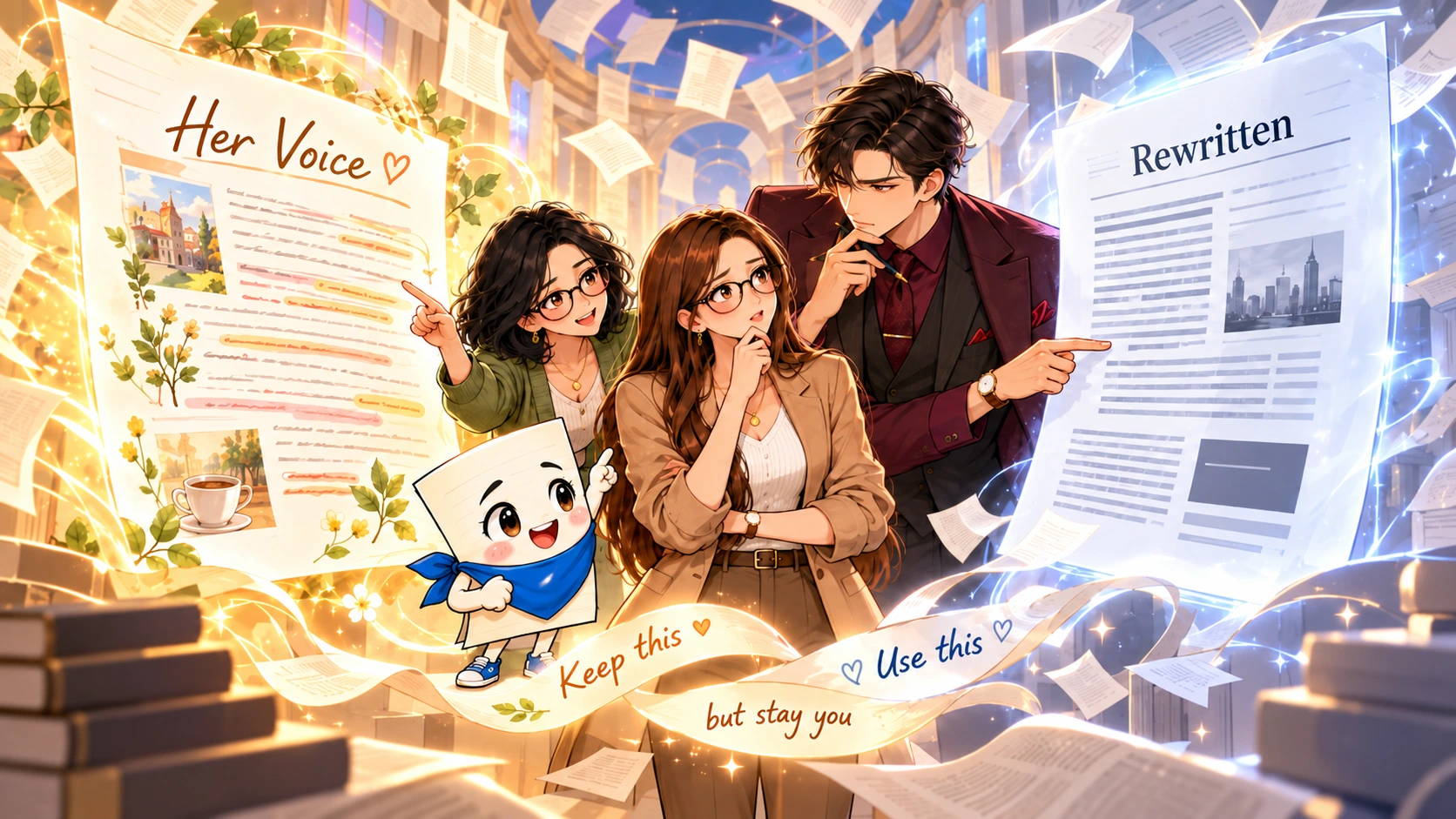
“My voice isn't every mistake I make.”
Scribe watched her.
Patricia continued.
“If a sentence is unclear, I want to fix it. If a word is wrong, I want to change it. If my tone causes a problem, I want to know.”
She took a breath.
“But if the only problem is that you would say it differently, I want to decide whether that difference matters.”
Scribe's expression changed slightly.
Not agreement.
Not yet.
Interest.
“That is a more defensible position.”
Patricia smiled.
“That sounds like the nicest thing you're going to say today.”
“It probably is.”
Draft covered a laugh.
Scribe looked back at the article.
“Then show me.”
“What?”
“Show me which changes improve clarity and which ones merely change your voice.”
Patricia had not expected that.
The Review of the Review
They went through the article again.
This time, Patricia did not treat every comment as an order.
They treated each one as a question.
One sentence was too long.
Patricia shortened it.
Scribe agreed.
One paragraph repeated the same idea twice.
Patricia removed the repetition.
Mr. Red Pen, listening nearby, approved enthusiastically.
Then they reached the sentence:
Sometimes I know what I mean, but I need a little more time to find the clearest way to say it.
Scribe preferred:
Sometimes my intended meaning is clear to me before I determine the most precise phrasing.
Patricia read both aloud.
“The second one sounds more formal.”
“Yes.”
“Is the first unclear?”
“No.”
“Incorrect?”
“No.”
“Then I'm keeping the first.”
Scribe looked unconvinced.
But he nodded.
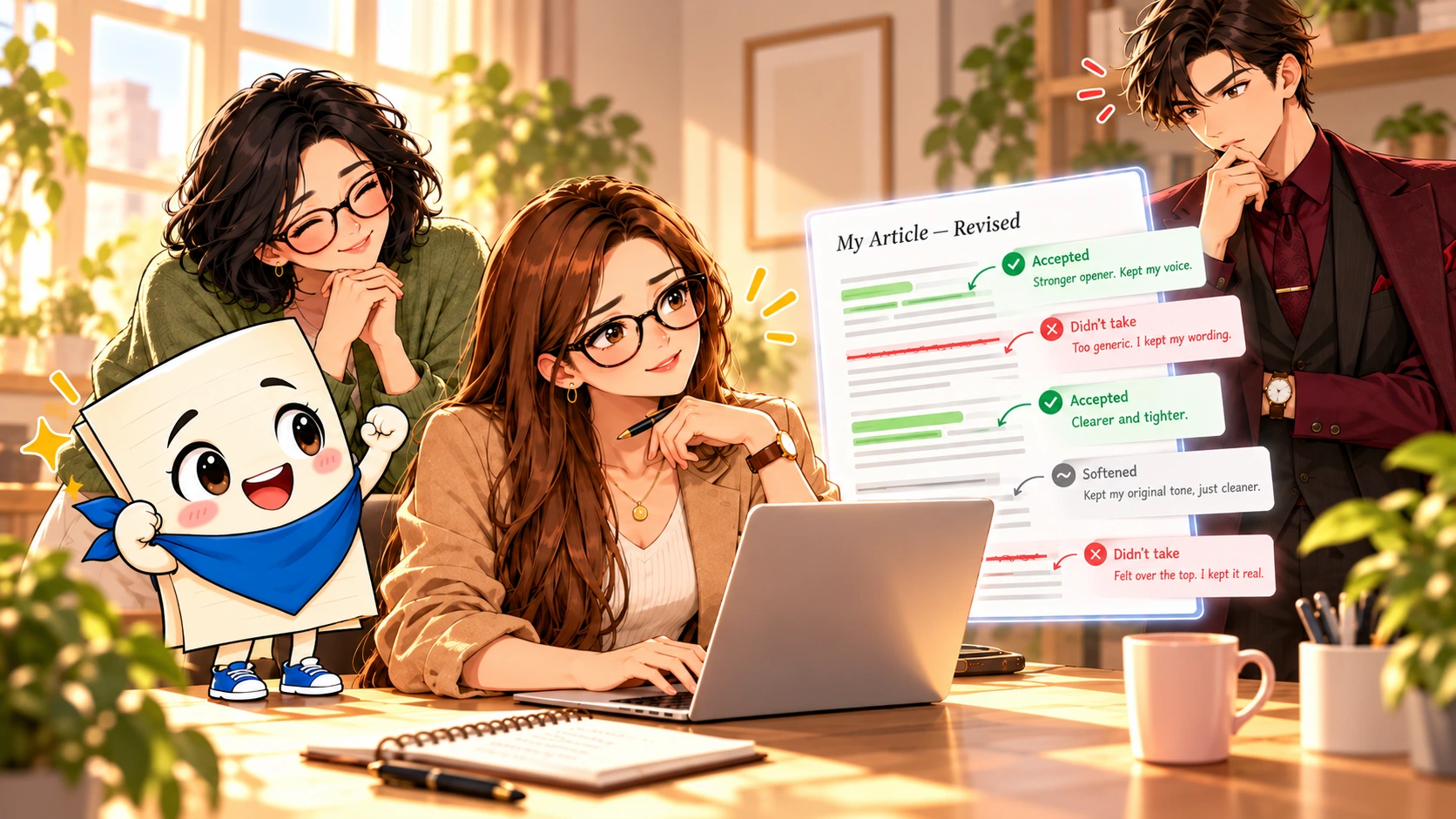
They continued.
At another sentence, Patricia defended the original.
Scribe explained that the word choice carried a slightly different meaning than she intended.
This time, Patricia changed it.
At another, Scribe suggested a complete rewrite.
Patricia asked why.
He explained.
The original sentence buried the main idea beneath two extra clauses.
Patricia rewrote it herself instead of using Scribe's version.
Scribe read her revision.
“Better.”
“Better than yours?”
“No.”
Patricia smiled.
“Still keeping mine.”
By the end of the discussion, something had changed.
Not in the article.
Between them.
Scribe had stopped saying “I'd rewrite it” as if that ended the conversation.
Patricia had stopped assuming every disagreement meant she was wrong.
Draft watched quietly.
This was exactly what he wanted.
Not obedience.
Not rejection.
Understanding.
Keep My Voice
After the call, Patricia returned to the article one final time.
She opened the revised version and the original side by side.
Instead of asking which one sounded more native, she asked a different set of questions.
Is the meaning clear?
Is the sentence correct?
Does the tone fit?
Does this edit solve a real problem?
Does the sentence still sound like me?
Draft sat beside the keyboard.
“Those questions look familiar.”
Patricia smiled.
“They're better than ‘Would Scribe write it this way?’”
“Much better.”
Patricia restored several original lines.
She kept many of Scribe's structural edits.
She rewrote confusing sections in her own words.
The article became cleaner.
But it also became warmer.
The memory about checking the email returned.
The small joke Paige had laughed at returned.
The final paragraph returned almost exactly as Patricia had first written it:
Writing clearly does not mean becoming a different person. I want my English to improve, but I still want the words to feel like mine.
She stopped there.
For once, she did not touch it again.
Draft looked at the paragraph.
“Keep My Voice.”
Patricia glanced at him.
“What?”
“That's what you're doing.”
She considered the phrase.
Not Keep Everything.
Not Never Edit Me.
Keep My Voice.
The difference mattered.
Improving her writing did not require protecting every sentence.
It required understanding what an edit was changing and why.
Patricia saved the final version.
A few minutes later, she sent it back to Scribe.
His reply came sooner than she expected.
Better.
Patricia smiled.
Then another message appeared.
I still would've written parts of it differently.
She laughed.
Of course.
She typed:
I know.
Three dots appeared.
Then:
That may be the point.
Patricia read the message twice.
Draft leaned over her arm.
“Did Scribe just admit something?”
“Almost.”
Mr. Red Pen looked disappointed.
“No dramatic apology?”
“No.”
“Public declaration that Patricia was correct?”
“No.”
“Defeat?”
“Definitely not.”
Mr. Red Pen sighed.
Patricia did not mind.
She had not needed to defeat Scribe.
She needed to stop treating his voice as the finish line for her own.
The Article Goes Live
Three days later, Patricia's article was published.
She opened the page from her desk.
Her name appeared beneath the title.
For a few seconds, she did not read anything else.
She had published work before.
Still, this one felt different.
The article contained edits from Scribe.
Suggestions from Paige.
Questions from Draft.
Even a punctuation correction from Mr. Red Pen.
But when Patricia read it, she still recognized herself.

That was what she had been afraid of losing.
A comment appeared beneath the article later that afternoon.
English is my second language too. I always thought good writing meant hiding that. This made me feel differently.
Patricia read the comment slowly.
Then again.
She looked toward Draft.
He was sitting beside the laptop, swinging his paper legs.
“If I had used Scribe's version for everything,” Patricia said, “the article might have sounded more polished.”
“Maybe.”
“But this reader recognized themselves in it.”
Draft nodded.
Patricia returned to the comment.
For years, she had wanted her English to become invisible.
No mistakes.
No awkwardness.
No clue that she had learned the language later in life.
Now she wondered whether that had ever been the right goal.
Clear writing mattered.
Correct writing mattered.
Natural writing mattered.
But sounding exactly like someone else was not the same thing as improving.
Mr. Red Pen climbed onto the notebook.
“So what are we writing down for today's lesson?”
Patricia opened to a new page.
There was no new Draftling to record this time.
That felt appropriate.
The problem had not been hiding inside a sentence.
It had been hiding inside Patricia's idea of what a “good writer” was supposed to sound like.
She wrote:
Not every edit is a correction.
Below it:
Ask what the edit improves before accepting it.
Then, after a moment, she added one final line.
Improve the writing. Keep the writer.
Draft read it.
His smile widened.
Mr. Red Pen adjusted his glasses.
“I like it.”
Patricia raised an eyebrow.
“No punctuation complaint?”
“You included the period.”
“I'm learning.”
From the laptop, another notification appeared.
A new comment on the article.
Then another.
Patricia opened the first one.
She did not wonder whether the reader could tell English was not her first language.
For the first time, that question felt unimportant.
What mattered was simpler.
Did they understand her?
They did.
And when Patricia read the article again, she understood something too.
The words were better than when she started.
And they were still hers.