The Story
Patricia had learned that some writing problems announced themselves loudly.
A wrong word could look wrong.
A missing punctuation mark could make Mr. Red Pen gasp dramatically.
An angry-sounding email could summon Tonebug before Patricia had even pressed Send.
But other problems were quieter.
They sat inside sentences that looked perfectly normal.
That was what made them dangerous.
Patricia was working on a short profile for a client’s website. The article introduced two women who had started a small design company together.
Their names were Anna and Maria.
Patricia had interviewed both of them the day before.
Anna handled the business side.
Maria led the design work.
The story was simple.
At least, Patricia thought it was.
She typed:
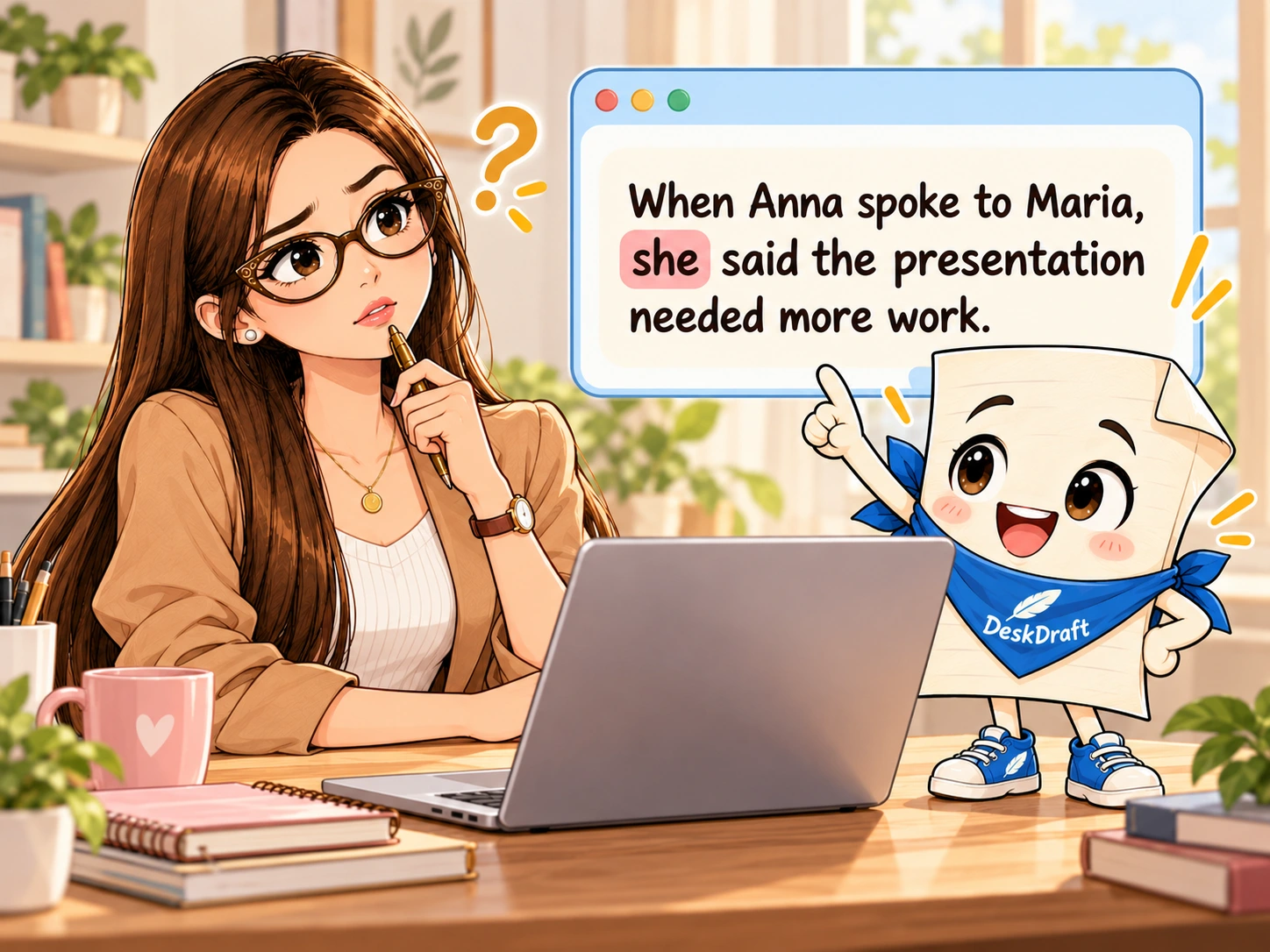
When Anna spoke to Maria after the meeting, she said the presentation needed more work.
Patricia read the sentence.
Nothing looked wrong.
The grammar was correct.
The spelling was correct.
Mr. Red Pen, who had been walking across her desk with a tiny ruler, stopped beside the laptop.
He adjusted his glasses.
“No obvious error.”
Patricia smiled.
“That sounded painful for you.”
“I am simply reporting the facts.”
Draft climbed onto the edge of the keyboard.
He read the sentence once.
Then twice.
His smile faded.
Patricia noticed.
“What?”
Draft pointed at the screen.
“Who said the presentation needed more work?”
“Anna.”
Draft looked back at the sentence.
“Are you sure?”
Patricia blinked.
“Of course I’m sure. I wrote it.”
“That was not my question.”
Patricia leaned closer to the screen.
When Anna spoke to Maria after the meeting, she said the presentation needed more work.
She.
Patricia read it again.
Then a third time.
“Oh.”
Mr. Red Pen looked offended.
“What?”
Patricia pointed.
“‘She’ could mean Anna.”
“Yes.”
“Or Maria.”
Mr. Red Pen froze.
He looked at the sentence.
Then at Patricia.
Then at Draft.
“That is deeply inconvenient.”
Draft laughed.
Patricia placed both hands on the desk.
“But the sentence is grammatically correct.”
Draft nodded.
“That does not mean the reader knows what you mean.”
Patricia stared at the sentence.
The problem had been invisible until someone asked one simple question.
Who is she?
The First Reader
Patricia decided to test the sentence on Paige.
That afternoon, they met at a café near Patricia’s apartment.
Paige arrived with her usual canvas tote bag and a notebook tucked under one arm.
Patricia opened her laptop.
“I need you to read one sentence.”
Paige sat down.
“That sounds suspiciously easy.”
“It should be easy.”
Patricia turned the laptop toward her.
Paige read:
When Anna spoke to Maria after the meeting, she said the presentation needed more work.
Paige looked up.
“Who said it?”
Patricia groaned.
“You too?”
Paige smiled.
“So there is a correct answer?”
“Anna.”
“I thought Maria.”
Patricia dropped her forehead onto one hand.
“That is worse.”
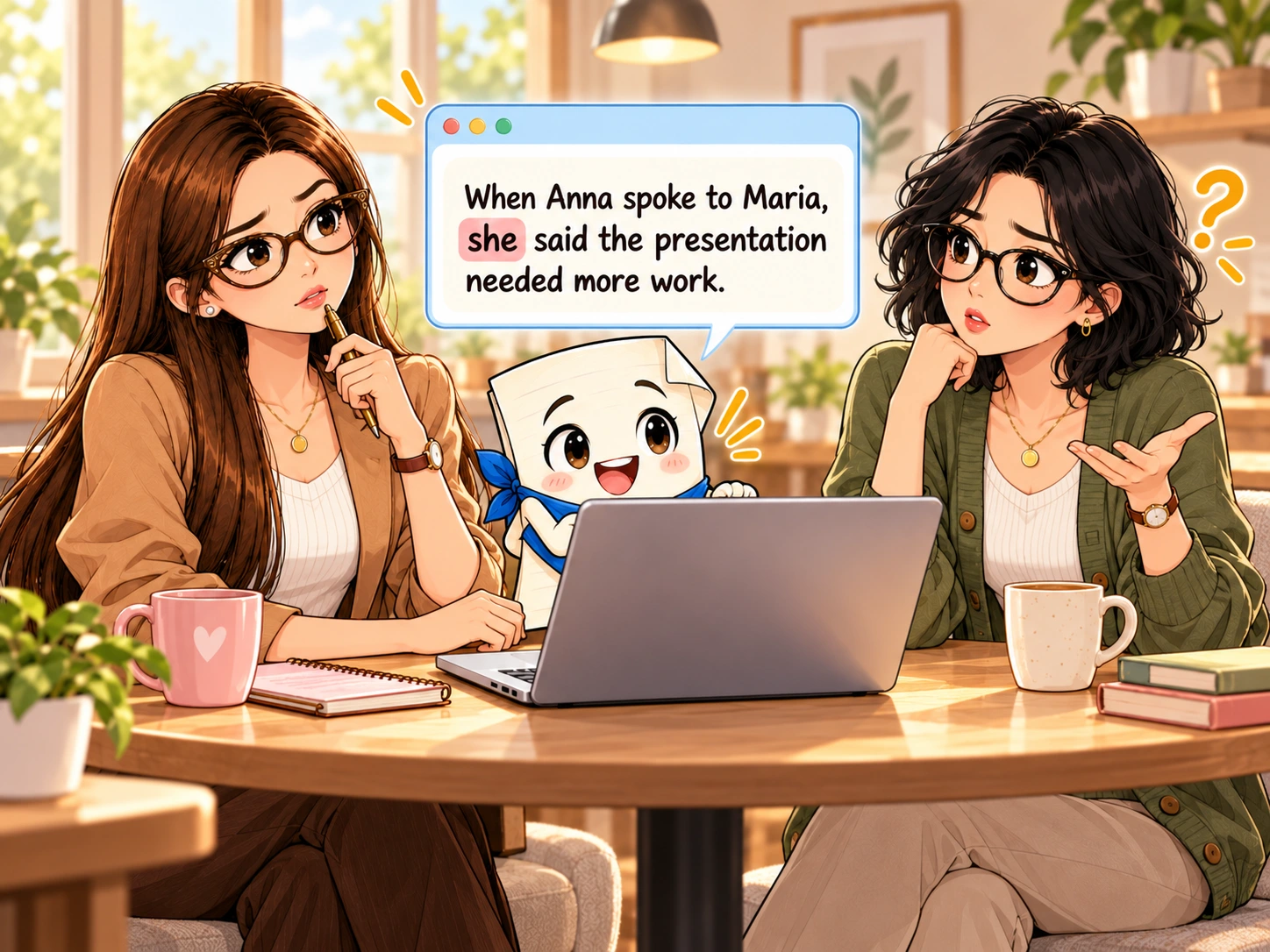
“It is not terrible,” Paige said. “I just had to stop.”
Draft, sitting beside Patricia’s coffee cup, pointed toward Paige.
“That is the problem.”
Paige nodded.
“When I have to stop and ask who a word refers to, I am no longer reading the story. I am solving it.”
Patricia looked back at the sentence.
She changed it:
When Anna spoke to Maria after the meeting, Anna said the presentation needed more work.
Paige read it.
“Clear.”
Patricia frowned.
“But repeating Anna feels awkward.”
“Maybe. But I knew what happened.”
Draft raised one finger.
“Clarity first. Elegance second.”
Mr. Red Pen, who had insisted on joining them inside Patricia’s bag, climbed onto the table.
“I support elegance.”
Paige looked at him.
“You support commas.”
“I support civilization.”
Patricia laughed.
Then she scrolled farther down the article.
“There might be more.”
There were.
In the next paragraph, Patricia had written:
Maria showed Anna the new logo after she finished the revisions.
Paige pointed.
“Who finished the revisions?”
Patricia opened her mouth.
Then stopped.
“Maria.”
“I guessed Anna.”
Another sentence:
Anna emailed Maria before she sent the final files.
Paige raised an eyebrow.
Patricia sighed.
“Maria sent them.”
“I thought Anna did.”
Draft looked toward the screen.
“Three sentences. Same problem.”
Patricia rubbed her forehead.
“How did I not notice this?”
“Because you already know what happened,” Paige said.
The answer was simple.
And uncomfortable.
Patricia knew the interviews.
She knew who had said what.
She knew which person had revised the logo.
She knew who had sent the files.
Her brain automatically filled in the missing information.
The reader’s brain could not.
Something moved near the bottom of the screen.
At first Patricia thought it was a shadow.
Then the words on the page blurred slightly.
A pale gray mist crawled between the lines.
Draft stood up.
“Oh.”
Paige looked toward him.
“That sounds like an ‘oh’ I should worry about.”
The mist thickened.
Two small glowing eyes appeared inside it.
Then a round creature drifted out of the paragraph.
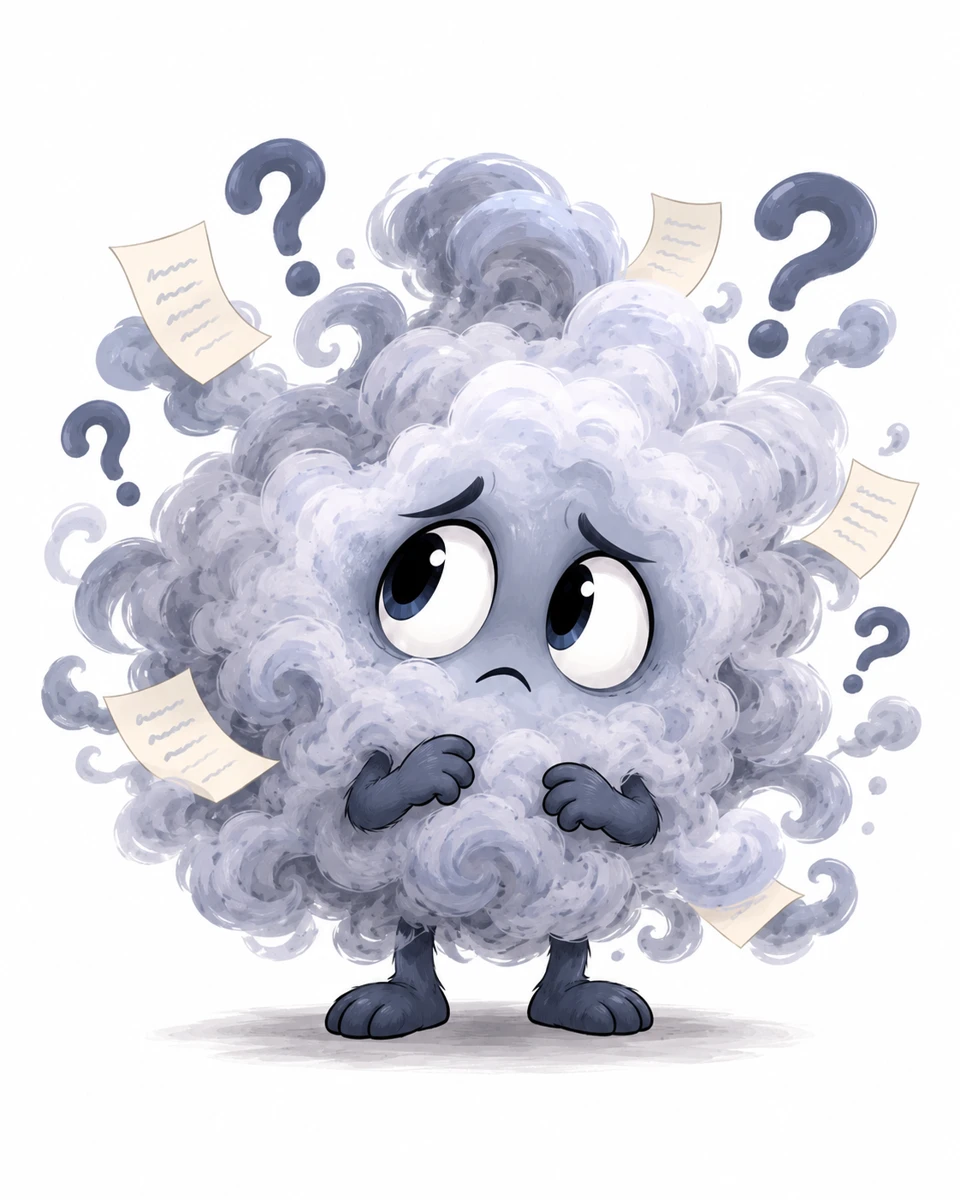
It looked like a tiny cloud wrapped in a soft gray scarf. Its edges were blurry, as though someone had drawn it and then rubbed half of it away.
It blinked slowly.
Patricia stared.
“You have got to be kidding me.”
The creature floated between the words Anna and Maria.
Then it covered both names with fog.
Draft sighed.
“Foggy.”
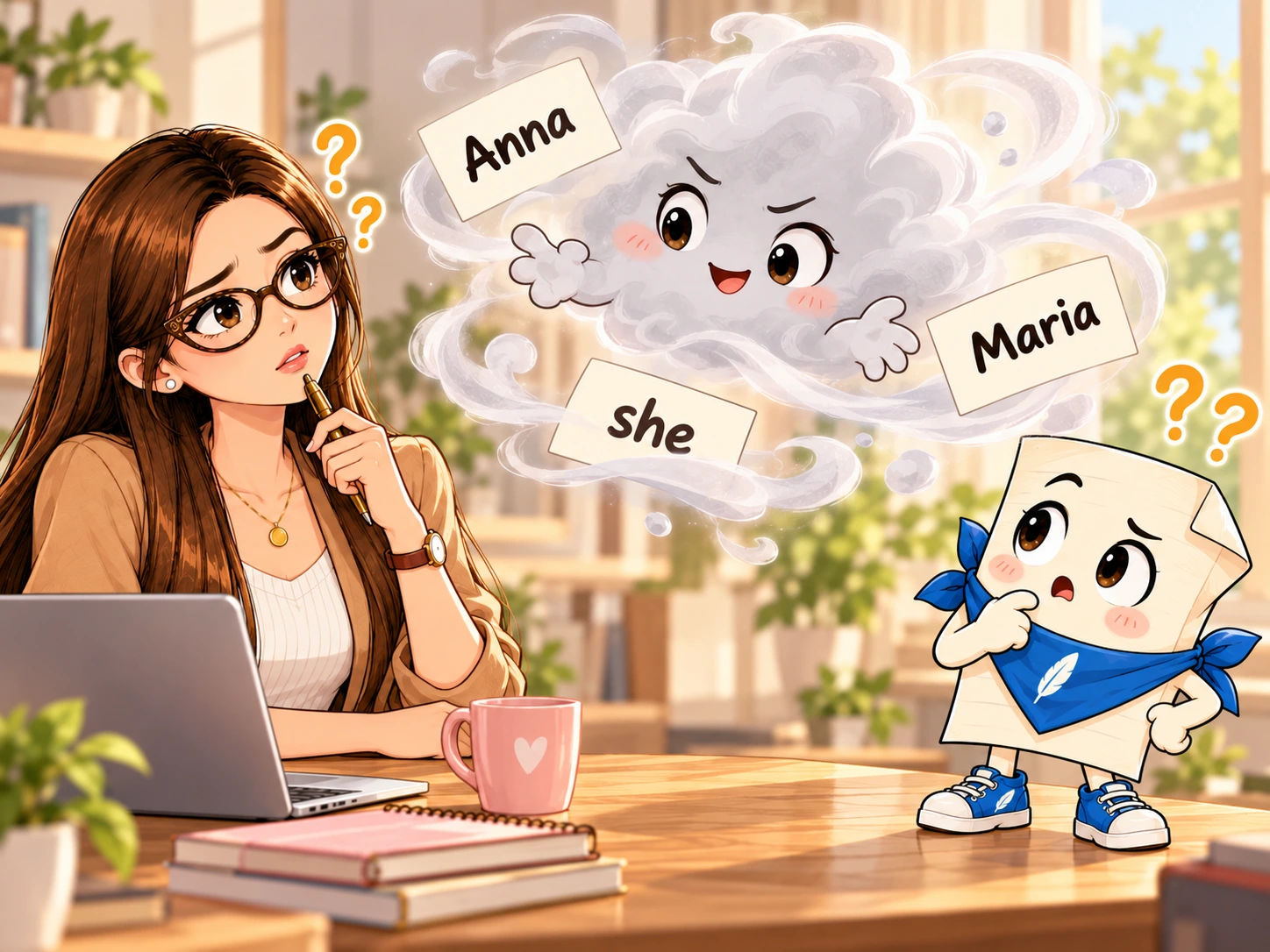
The creature smiled.
Foggy
Foggy did not attack sentences.
Foggy hid the connections inside them.
Where did “she” point?
What did “it” mean?
Which idea did “this” refer to?
Foggy loved any sentence that made the reader guess.
Patricia reached toward the creature.
Foggy drifted away and settled on another paragraph.
The words beneath it became hazy.
Paige leaned closer.
“It is kind of cute.”
Foggy puffed proudly.
Draft shook his head.
“Do not encourage it.”
Patricia opened DeskDraft’s Clarity Checks.
A small notice appeared beside the first sentence:
Possible unclear reference: “she”
Two possible people are mentioned before this pronoun.
Patricia clicked the explanation.
DeskDraft highlighted Anna and Maria.
Then it highlighted she.
Patricia nodded slowly.
“That is useful.”
Mr. Red Pen looked disappointed.
“There is still no grammar error.”
“Exactly,” Draft said. “This is a reader problem.”
The Draftspace
The screen brightened.
The café disappeared.
Patricia, Draft, Paige, and Foggy were standing inside Draftspace.
A giant sheet of paper stretched beneath them.
Above it floated several sentences from Patricia’s article.
The first sentence hung in the air:
When Anna spoke to Maria after the meeting, she said the presentation needed more work.
Two glowing paths extended from she.
One led toward Anna.
The other led toward Maria.
Foggy danced between them.
Patricia watched the paths cross.
“So the reader sees both possibilities.”
Draft nodded.
“You know which path you intended. The sentence does not.”
Paige pointed toward another floating sentence.
Maria showed Anna the new logo after she finished the revisions.
Again, two paths appeared.
Foggy split into two smaller clouds and sat on both.
Patricia folded her arms.
“This is annoying.”
Foggy seemed delighted.
Draft walked toward the sentence.
“There are several ways to fix ambiguity.”
The words shifted.
Option 1:
After Maria finished the revisions, she showed Anna the new logo.
The path became clear.
Foggy shrank.
Option 2:
Maria showed Anna the new logo after Maria finished the revisions.
Foggy became smaller again.
Option 3:
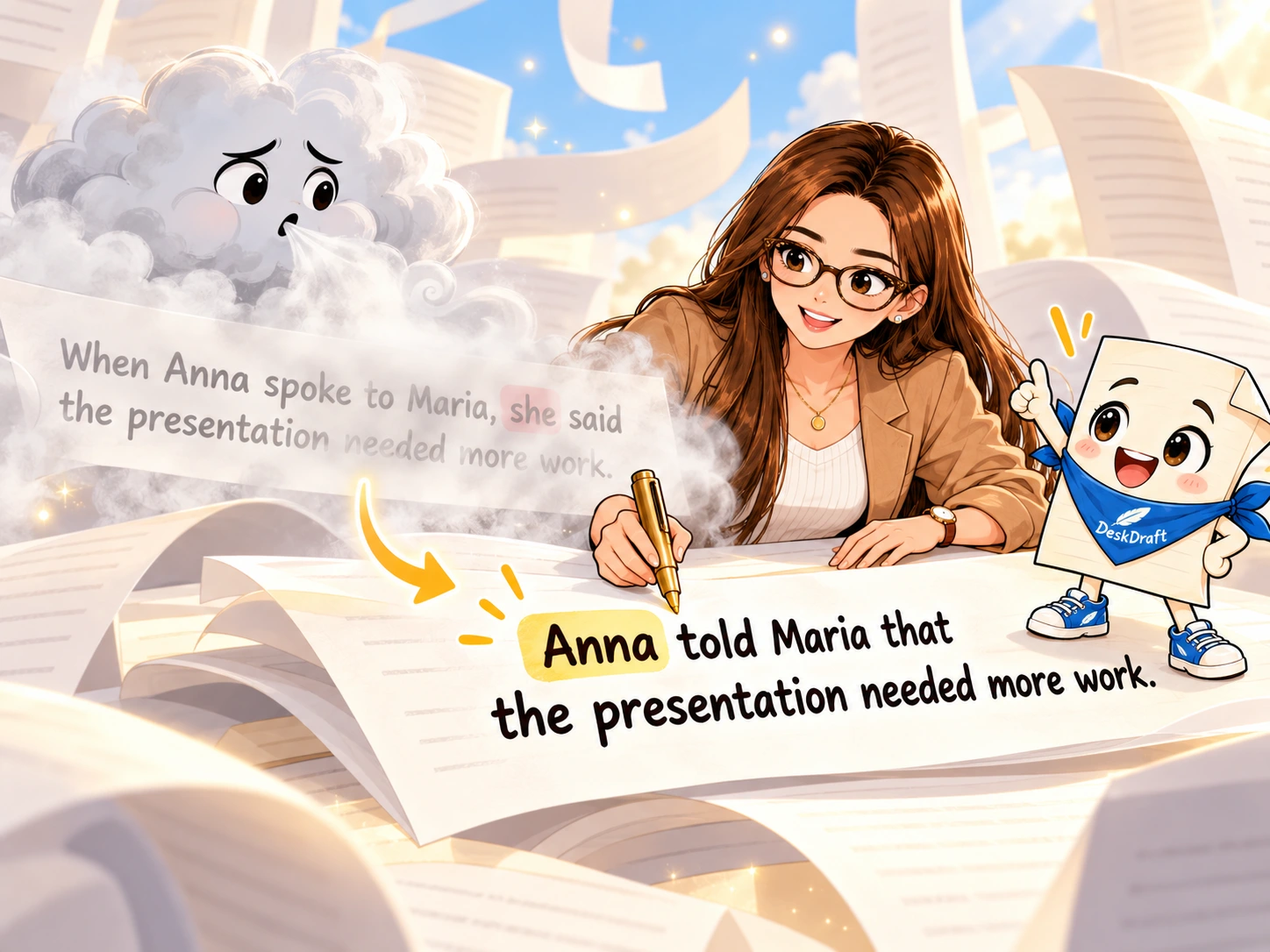
After finishing the revisions, Maria showed Anna the new logo.
Foggy disappeared completely.
Patricia smiled.
“So I do not always have to repeat the name.”
“No,” Draft said. “You just have to make the relationship obvious.”
Paige pointed at the third version.
“That one feels natural.”
Patricia nodded.
The next sentence floated toward them:
Anna emailed Maria before she sent the final files.
Patricia thought for a moment.
Then rewrote it herself:
Before Maria sent the final files, Anna emailed her.
One path.
One clear meaning.
Foggy made a tiny disappointed sound.
Mr. Red Pen appeared from behind a floating comma.
“I am beginning to enjoy this.”
Patricia looked at him.
“Because it involves rewriting?”
“Because confusion is disorder.”
Back at the Desk
That evening, Patricia reviewed the full article again.
This time she did not only check whether each sentence was correct.
She asked:
If I did not already know this story, would I understand it?
Every time she saw he, she, it, they, this, that, or which, she paused.
Not because those words were bad.
Most of them were perfectly clear.
But some depended too heavily on information that existed only inside Patricia’s head.
She found another sentence:
The team sent the proposal to the client after they approved the budget.
Who approved the budget?
The team?
The client?
Patricia rewrote it:
After the client approved the budget, the team sent the proposal.
Foggy, sitting on top of a notebook, became slightly smaller.
Another:
Patricia reviewed the notes with Paige before she updated the draft.
She laughed.
“That one is about us.”
Paige, who was still on a video call, read it.
“Who updated the draft?”
“I did.”
“Then say that.”
Patricia changed it:
Before Patricia updated the draft, she reviewed the notes with Paige.
Clear.
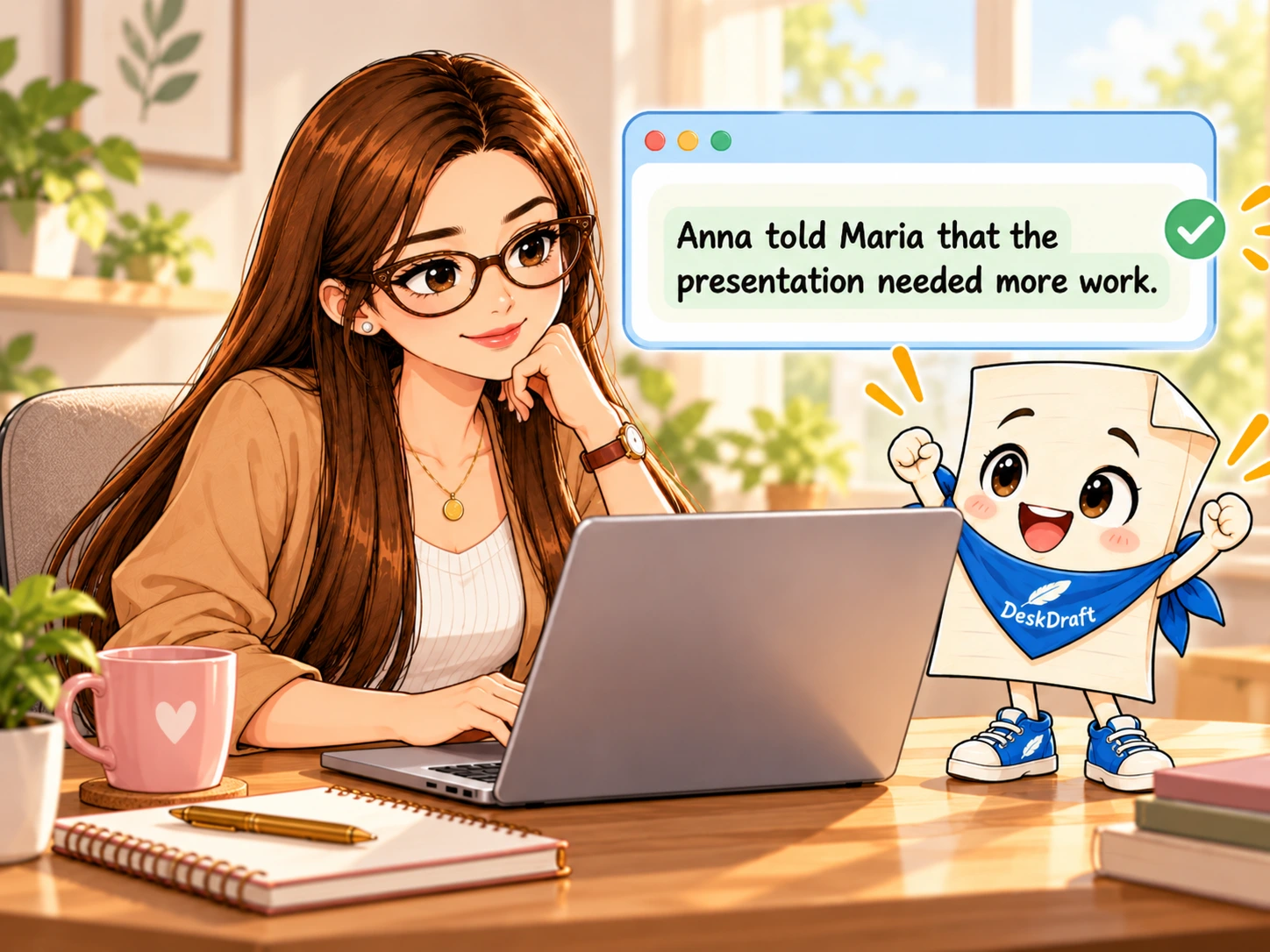
Another patch of mist disappeared.
By the end of the review, Foggy was small enough to fit inside Patricia’s coffee mug.
Patricia looked at the article.
It had not become simpler because she removed difficult words.
It had become simpler because the reader no longer had to guess.
That difference mattered.
The Client Reply
Patricia sent the revised profile the next morning.
A few hours later, the client replied.
Thanks, Patricia. This reads smoothly. The story is easy to follow, especially the parts where Anna and Maria are both involved.

Patricia read the message twice.
That was exactly where the original version had been weakest.
Draft leaned over her arm.
“They noticed the clarity.”
“They did not know there was a clarity problem before.”
“They do not need to.”
Patricia smiled.
That was becoming one of her favorite things about good editing.
Sometimes the best correction was one the reader never noticed.
They simply kept reading.
The Notebook
Patricia opened the notebook where she recorded Draftlings.
Foggy floated beside her, now no larger than a cotton ball.
She wrote:
Draftling #003 - Foggy
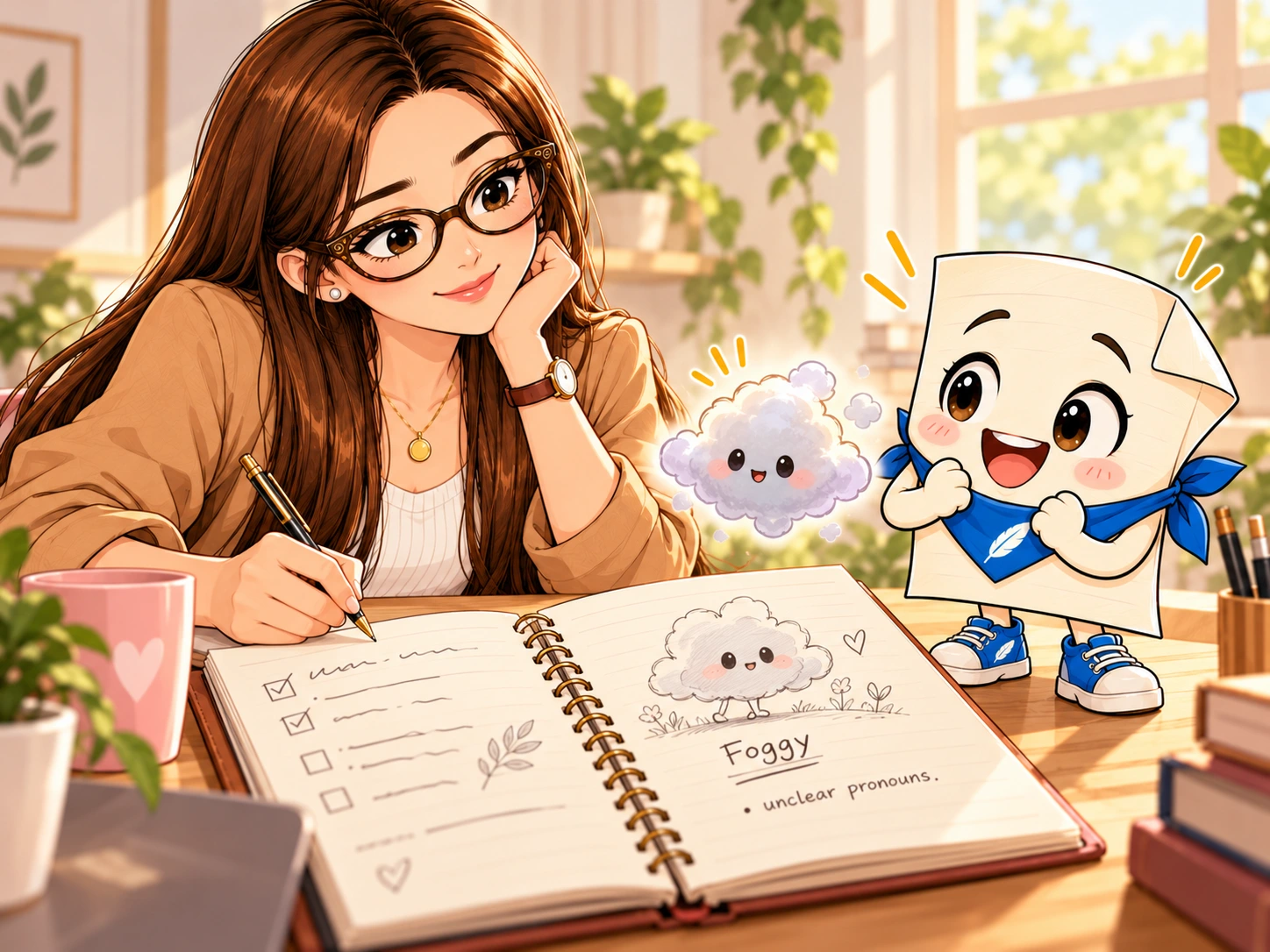
Represents: Unclear references and ambiguous meaning.
Weakness: Make the connection obvious. Name the person or thing when the reader could reasonably be confused.
DeskDraft Feature: Clarity Checks.
Foggy leaned over the page.
A thin layer of mist covered the word obvious.
Patricia erased it with one finger.
“Nice try.”
Draft laughed.
Patricia added one final note:
Correct does not always mean clear.
She thought for a moment.
Then wrote underneath:
If the reader has to guess, the sentence is not finished yet.
Paige read the line over video call.
“I like that.”
Mr. Red Pen adjusted his glasses.
“No punctuation errors.”
Patricia looked at him.
“You are really growing.”
“I regret saying anything.”
Foggy floated onto the corner of the notebook and curled up.
Patricia looked back at the finished article.
Anna was Anna.
Maria was Maria.
She was whoever Patricia clearly said she was.
And for the reader, the fog was gone.