The Story
Patricia noticed the problem because of one letter.
She had been editing a short article for most of the morning, and by lunchtime the document finally looked clean. The paragraphs flowed well. The examples made sense. Even Mr. Red Pen had been unusually quiet.
That should have worried her.
Instead, Patricia took it as a good sign.
The article was for a client whose audience was mostly in the United States. It was not especially long, but it mattered. Patricia wanted the writing to feel polished, professional, and easy to read.
She reached the final paragraph and stopped.
One sentence read:
The new color options make the product easier to customize.
A few lines later, another sentence read:
Users can choose their preferred colour and save it for future projects.
Patricia stared at the two words.
Color.
Colour.
She had seen both hundreds of times.
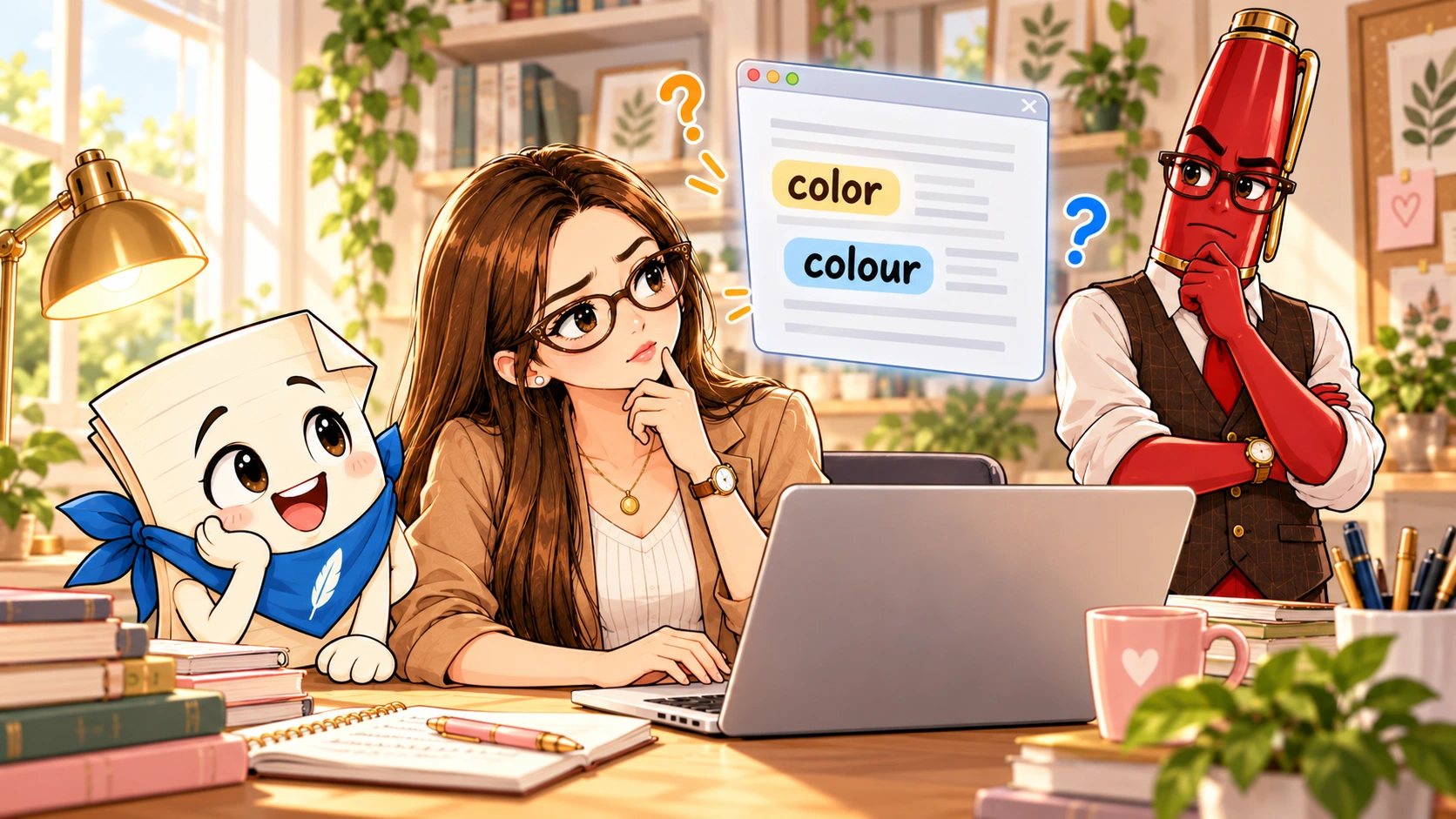
One looked familiar from American websites and software menus.
The other looked familiar from books, articles, and teachers who had used British English.
Until now, Patricia had never thought much about why both existed.
She highlighted colour.
Then she changed it to color.
She paused.
A memory surfaced from school.
Her teacher writing colour on the board.
Patricia changed it back.
Then she stared at color in the earlier paragraph.
Maybe that was the wrong one.
She changed color to colour.
Now the first sentence looked strange.
Patricia frowned.
She changed it back.
Then she changed the second one again.
For several minutes, the article did not improve at all. Only one letter kept appearing and disappearing.
Draft, who had been sitting near the corner of the laptop, finally looked up from a small stack of paper notes.
“You’ve changed that word six times.”
Patricia kept her eyes on the screen.
“I know.”
“Are you testing the keyboard?”
“No.”
“Then what are you doing?”
Patricia pointed.
“Which one is correct?”
Draft looked at the two spellings.
“Both.”
Patricia turned toward him.
“That is not helpful.”
Mr. Red Pen slid across the desk as if he had been waiting for exactly this moment.
“Allow me.”
He adjusted his glasses and examined the document.
His expression grew serious.
He pointed to color.
“Correct.”
Then he pointed to colour.
“Also correct.”
Patricia stared at him.
Mr. Red Pen lowered his hand.
“I admit this is uncomfortable.”
Patricia leaned back in her chair.
Writing in English was difficult enough when there was one correct answer. Two correct answers felt unfair.
“If both are correct,” she said, “why does the document look wrong?”
Draft smiled slightly.
“That is a better question.”
Before Patricia could ask what he meant, a noise came from behind the laptop.
It was not the soft buzzing sound Tonebug had made.
This sounded more like an argument.
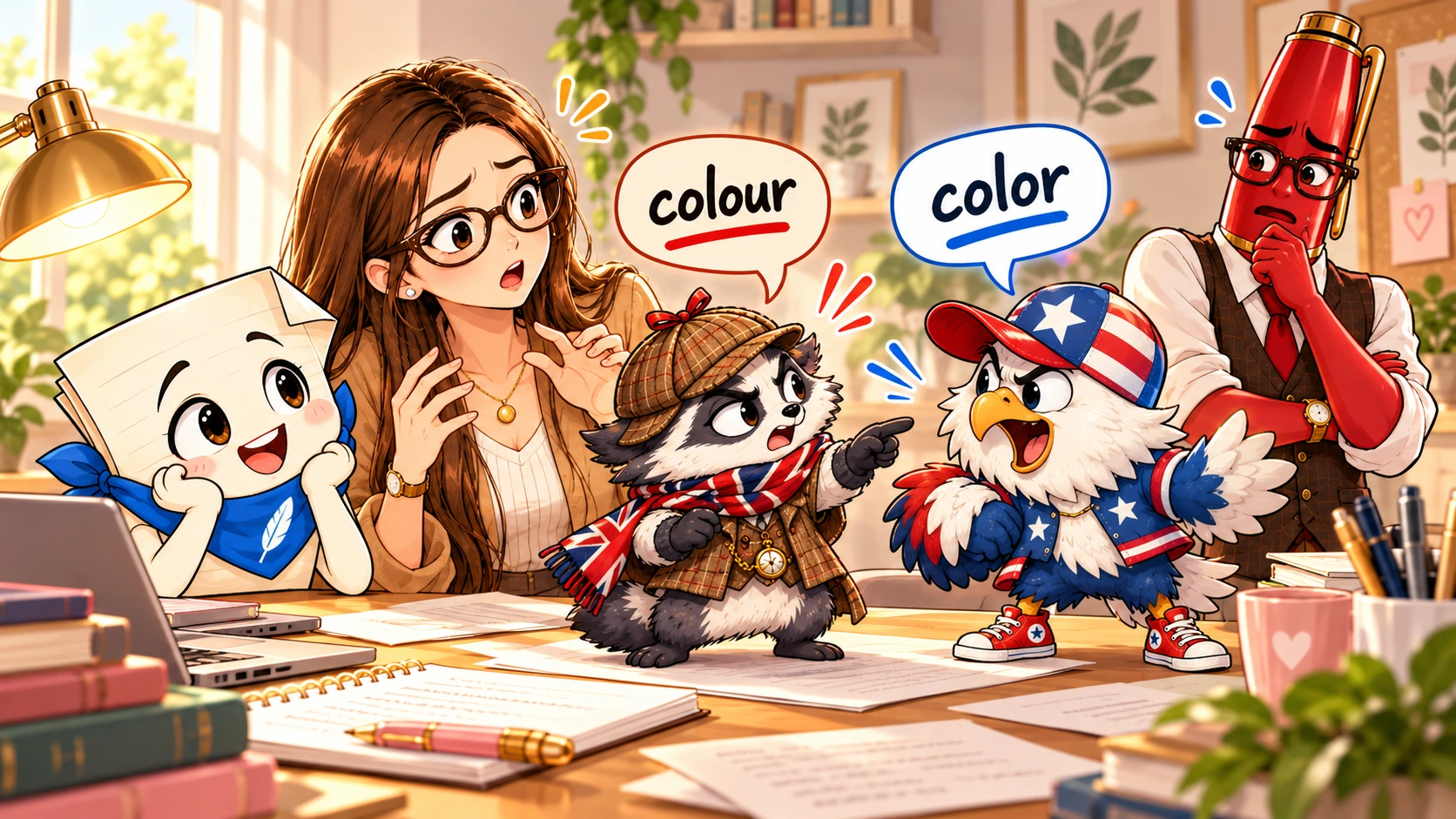
“Mine.”
“No, mine.”
“Yours has an unnecessary letter.”
“Yours is missing one.”
Patricia slowly looked around the side of the screen.
Two tiny creatures stood on top of her notebook.
One wore a small tweed cap and held a teacup with both paws. A red, white, and blue scarf hung neatly around its neck.
Beside it stood a confident little bird in a star-covered cap and bright sneakers, wings folded across its chest.
They were glaring at each other.
Draft sighed.
“Oh.”
Patricia recognized that tone now.
“What are they?”
The small creature with the teacup lifted its chin.
“Colour.”
The bird immediately stepped forward.
“Color.”
Patricia looked at Draft.
“Those are their names?”
“Not exactly.”
Draft climbed onto the notebook.
“Patricia, meet Brit and Ameri.”
The two creatures turned toward her at the same time.
Then they began arguing again.
The Argument in the Margins
Brit took a careful sip of tea and pointed toward the word colour.
“This is perfectly proper.”
Ameri gave an exaggerated laugh.
“It has an extra U.”
“It has the correct U.”
“According to who?”
“According to people who know how to spell.”
Ameri’s feathers puffed up.
Patricia raised both hands.
“Stop.”
The two Draftlings became quiet.
For about two seconds.
Then Brit pointed at the screen.
“She should use colour.”
Ameri shook its head.
“Client’s in the U.S. Use color.”
Brit adjusted the little cap.
“English did exist before software menus.”
Ameri pointed at the article.
“And the readers still live in America.”
Mr. Red Pen watched the argument with growing concern.
“I dislike situations where everyone has evidence.”
Patricia looked at Draft.
“Are they always like this?”
“Usually.”
“So which one do I listen to?”
Draft looked toward the article.
“First, tell me who you are writing for.”
“The client’s audience is mostly American.”
“Did the client give you a style preference?”
Patricia opened the project notes.
Near the top was a line she had skimmed earlier:
Language: US English.
She felt slightly embarrassed.
“I missed that.”
Draft did not criticize her.
He simply nodded toward Ameri.
Ameri grinned so widely that Brit nearly dropped the teacup.
“Then color is the better choice for this document,” Draft said.
Brit raised one paw.
“Objection.”
Draft looked at him.
“Is color incorrect?”
Brit hesitated.
“No.”
“Then what are you objecting to?”
Brit looked away.
“I object to the enthusiasm.”
Patricia laughed.
The question seemed solved.
She changed colour to color and moved on.
A few paragraphs later, she found organise.
She stopped again.
Then centre.
Then travelled.
Then favourite.
Patricia slowly scrolled upward.
The article was full of them.
Some sentences followed American spelling.
Others followed British spelling.
She had not noticed because every individual word had looked familiar.
Now the document seemed stitched together from two different versions of English.
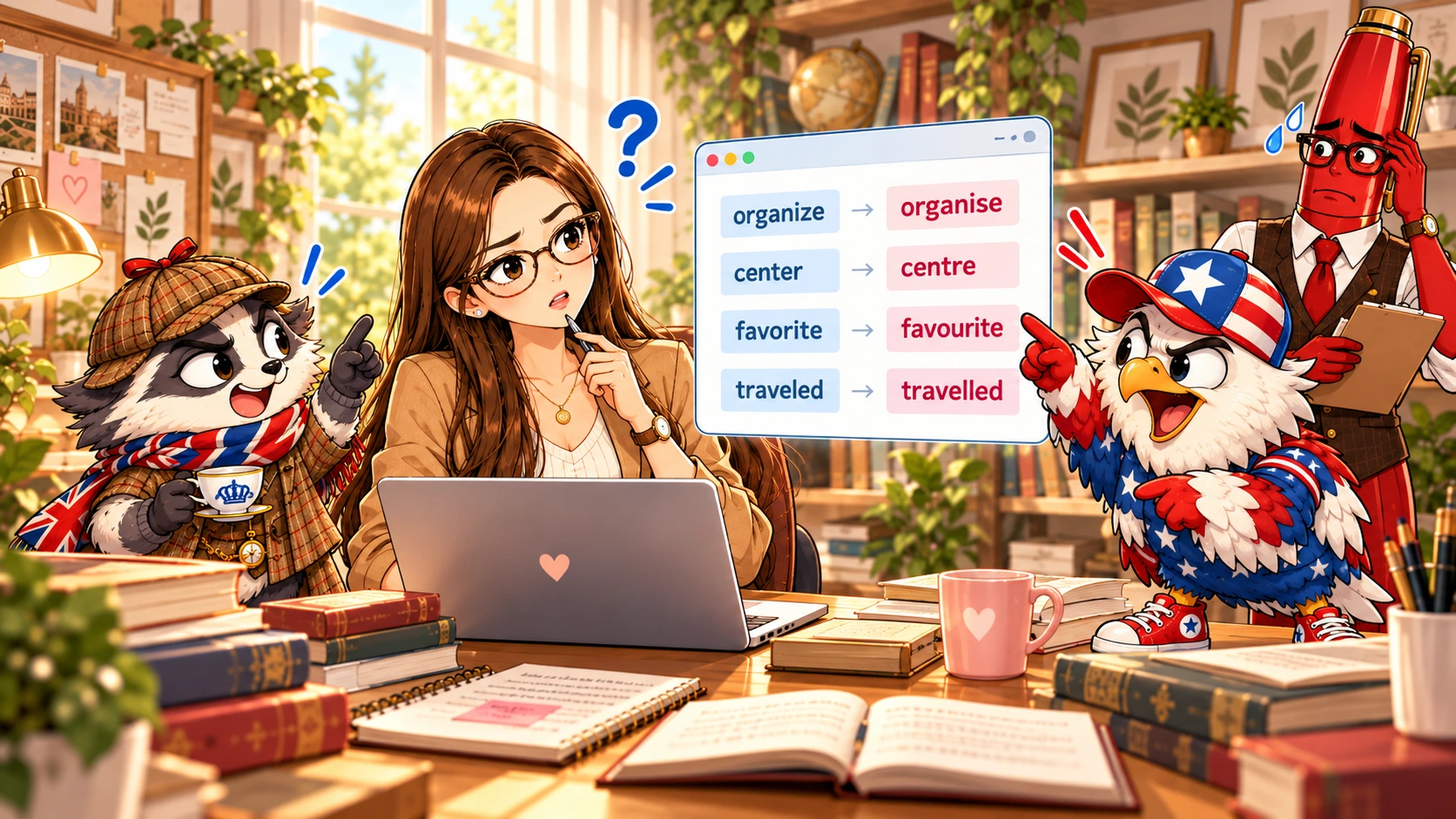
Brit and Ameri climbed onto opposite sides of the keyboard.
Each time Patricia found a word, one of them celebrated.
Organize.
Ameri cheered.
Organise.
Brit lifted the teacup in approval.
Center.
Ameri.
Centre.
Brit.
Favorite.
Ameri.
Favourite.
Brit.
Mr. Red Pen began pacing.
“This is chaos.”
Patricia rubbed her forehead.
“I thought the problem was one letter.”
Draft shook his head.
“The problem is consistency.”
That word made more sense.
Patricia had been asking which spelling was correct.
The better question was whether the entire document followed the same choice.
Inside Two Versions of English
Draft touched the edge of the laptop screen with his pen.
The familiar white surface of the Draftspace unfolded around them.
This time, the world divided almost immediately.
A blue line stretched down the middle of the page.
On Patricia’s left, signs read:
COLOUR
ORGANISE
CENTRE
TRAVELLED
FAVOURITE
On her right:
COLOR
ORGANIZE
CENTER
TRAVELED
FAVORITE
Brit walked proudly toward the left side.
Ameri hurried to the right.
Patricia stood between them.
At first, the two sides looked like opposites.
She expected one to fade or turn red.
Neither did.
Both remained clear.
Both looked complete.

Draft stood beside her.
“What do you notice?”
Patricia studied the lists.
“They’re different.”
“Yes.”
“But neither side looks broken.”
“Exactly.”
A path appeared through the American side. It led toward a group of readers standing beside a U.S. flag on a project brief.
Another path appeared through the British side. It led toward readers holding a different style guide.
Draft pointed toward both.
“English has different standard varieties. A spelling can be correct in one variety and different in another.”
Patricia looked at Brit and Ameri.
“So they aren’t really enemies.”
Brit and Ameri immediately answered together.
“We are.”
Draft ignored them.
“They represent different choices.”
Patricia walked toward the American side and picked up the word color.
The letters were solid.
Nothing about the word looked incomplete.
Then she crossed to the British side and picked up colour.
That word was solid too.
For years, Patricia had quietly assumed that when two spellings existed, one of them must be a mistake she had not yet learned to recognize.
It was a familiar fear.
English often made her feel that there was a secret correct version somewhere and that native speakers somehow knew it automatically.
But this was not a secret.
It was a choice shaped by audience, region, and style.
“So if I write for an American audience, I should use American English.”
“Usually, yes.”
“And if the audience expects British English?”
“Then British English may be the better fit.”
“And if nobody tells me?”
Draft smiled.
“Choose one appropriate version and stay consistent.”
Patricia looked down at the article.
A sentence floated between the two sides:
Our favorite colour is available in the center of the catalogue.
Brit and Ameri both looked offended.
Patricia laughed.
“That one really does look confused.”
Draft nodded.
“The reader may still understand it. But mixed conventions can make polished writing feel less consistent.”
Mr. Red Pen finally looked relieved.
“So there is something I can correct.”
“Yes,” Draft said.
Mr. Red Pen pulled out his red pen.
“Excellent.”
One Document, One Choice
The Draftspace disappeared.
Patricia returned to her desk with a much clearer plan.
She opened DeskDraft’s language setting and selected American English.
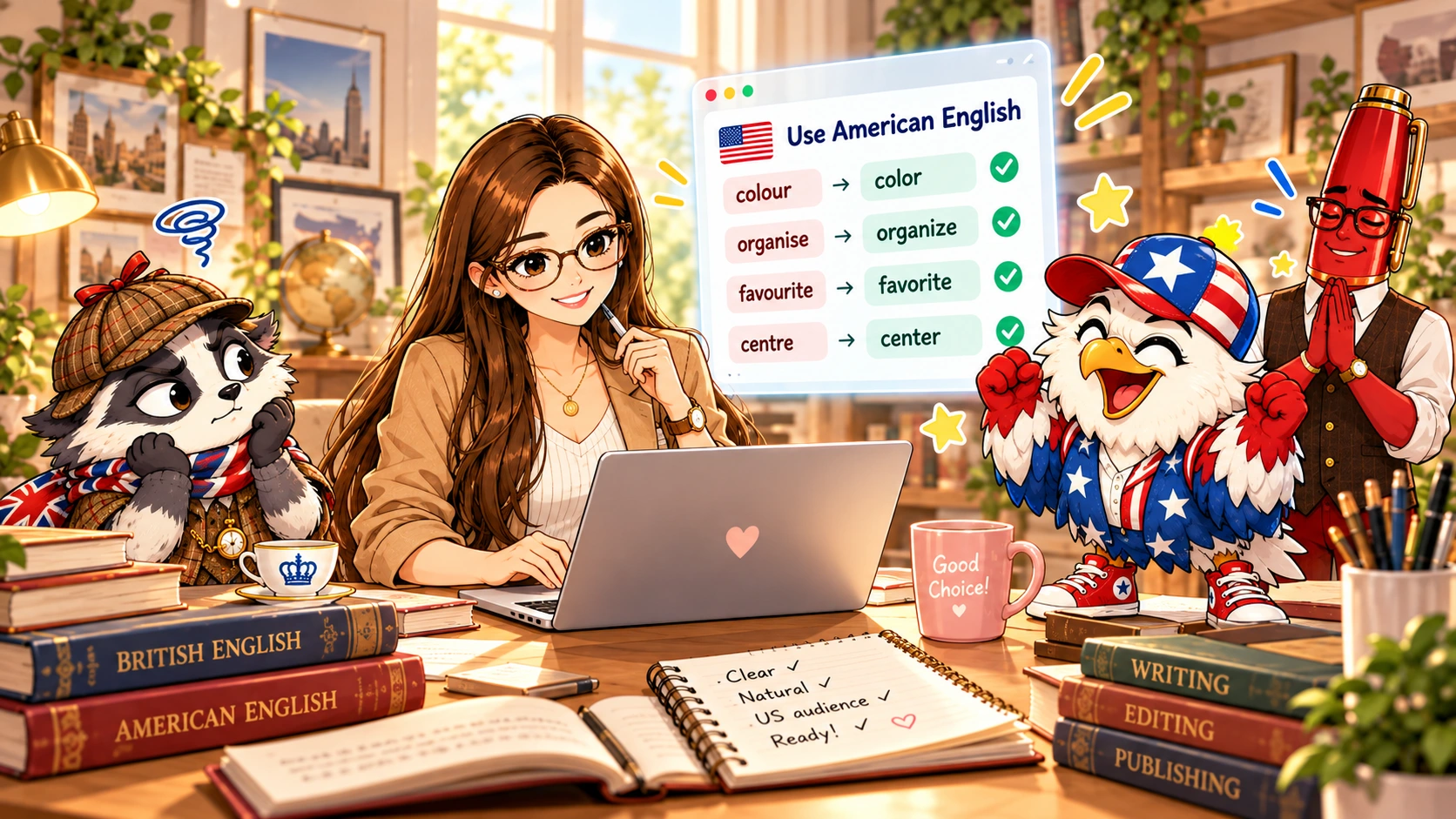
The document did not suddenly fill with red warnings.
Instead, the inconsistent words became easier to spot.
Colour became color.
Organise became organize.
Centre became center.
Favourite became favorite.
Travelling became traveling.
Patricia worked through the article carefully.
Brit followed behind her, occasionally sighing with dramatic disappointment.
Ameri celebrated every change until Draft asked him to stop distracting Patricia.
The most useful part was not that the software told Patricia one version was “better.”
It gave her a consistent reference.
That difference mattered.
She was not correcting British English because British English was wrong.
She was editing the article to match the audience and the client’s requested style.
When she reached the final paragraph again, Patricia read the article from beginning to end.
This time, nothing distracted her.
The spelling choices felt invisible.
That was probably the point.
The reader did not need to stop and wonder why one paragraph said color while another said colour.
The document simply felt consistent.
Patricia saved the file.
Ameri climbed onto the edge of the laptop.
“Looks good.”
Brit folded his arms.
“It would look equally good with proper British spelling.”
Ameri opened his beak.
Patricia pointed at both of them.
“No.”
They stopped.
She looked at Brit.
“You’re right that British English is correct.”
Brit smiled.
Then Patricia looked at Ameri.
“And you’re right that American English is correct.”
Ameri nodded proudly.
“But the client asked for US English, so today we’re using American English.”
Brit gave a dignified sigh.
“I can accept this.”
Ameri leaned toward Patricia.
“He cannot.”
“I heard that.”
Patricia laughed.
A Different Kind of Correct
Later that afternoon, Patricia received a short message from the client.
Thanks, Patricia. The article looks clean and consistent. Ready to publish.
She read the message twice.
The word consistent stood out more than clean.
That morning, Patricia had been trying to discover which spelling was correct.
By the end of the day, she understood that correctness could depend on context.
The lesson felt bigger than color and colour.
Sometimes English offered more than one valid choice.
The writer’s job was not always to hunt for a single universal answer.
Sometimes the job was to understand the reader, choose a standard, and use it with care.
Patricia opened the notebook where she had recorded Tonebug.
On the next page, she wrote:
Draftling #002 - Brit & Ameri
Brit immediately moved closer.
“Surely my name should come first.”
“It already does,” Patricia said.
Ameri looked over the notebook.
“For now.”
Patricia continued writing.
Represents: Mixing British and American English.
Then she added:
Both can be correct. Choose the version that fits the reader and keep it consistent.

She paused.
The sentence felt simple.
But she knew she would remember it.
Draft looked over her shoulder.
“Better than changing the same U six times?”
Patricia smiled.
“Much better.”
Mr. Red Pen examined the note.
“No errors.”
Patricia looked at him suspiciously.
“That’s all?”
He adjusted his glasses.
“I am capable of growth.”
Brit whispered something to Ameri.
Ameri tried not to laugh.
Mr. Red Pen turned.
“I heard that.”
The argument started again.
Patricia closed her notebook, still smiling.
On her laptop, the finished article waited to be published in American English.
On the desk, Brit insisted that centre looked more elegant.
Ameri insisted that center was faster because it had fewer letters.
Draft tried to explain that this was not how language worked.
Mr. Red Pen began making a list of every word they mentioned.
Patricia let them argue.
For once, she was not worried that one of them knew a secret rule she had missed.
She understood the choice.
And that was enough.