The Story
Patricia liked assignments with clear instructions.
This one looked especially simple.
The client wanted a long article about why clear communication mattered in remote teams.
Patricia had written about clarity before.
She understood the topic.
She had good examples.
She had a full afternoon with no meetings.
“This should be easy,” she said.
Draft looked up from a stack of notes.
“You said that before Novel Four.”
Patricia pointed at him.
“Do not bring history into this.”
She began writing.
The introduction came quickly.
Remote teams do not share the same room, so clear communication matters. When instructions are unclear, people lose time asking questions, correcting mistakes, and trying to understand what was meant.
Patricia nodded.
Good.
She continued.
Clear instructions help remote teams avoid confusion. When people understand what they need to do, they can work more efficiently and spend less time asking for clarification.
Still good.
A few paragraphs later:
Remote work depends on clear communication because team members cannot always ask questions immediately. Clear messages reduce confusion and make work easier to complete.
Patricia paused.
Something felt familiar.
She scrolled up.
Then down.
Then up again.
Draft watched.
“What?”
“I think I said the same thing.”
“Where?”
Patricia highlighted three paragraphs.
Draft read them.
“You did.”
“Exactly the same?”
“Not exactly.”
Patricia relaxed.
Draft continued.
“You used different words.”
Her shoulders dropped.
“That is not what I meant.”
Patricia read them again.
The first paragraph said unclear communication caused confusion and wasted time.
The second said clear instructions reduced confusion and saved time.
The third said clear messages reduced confusion and made work easier.
Different sentences.
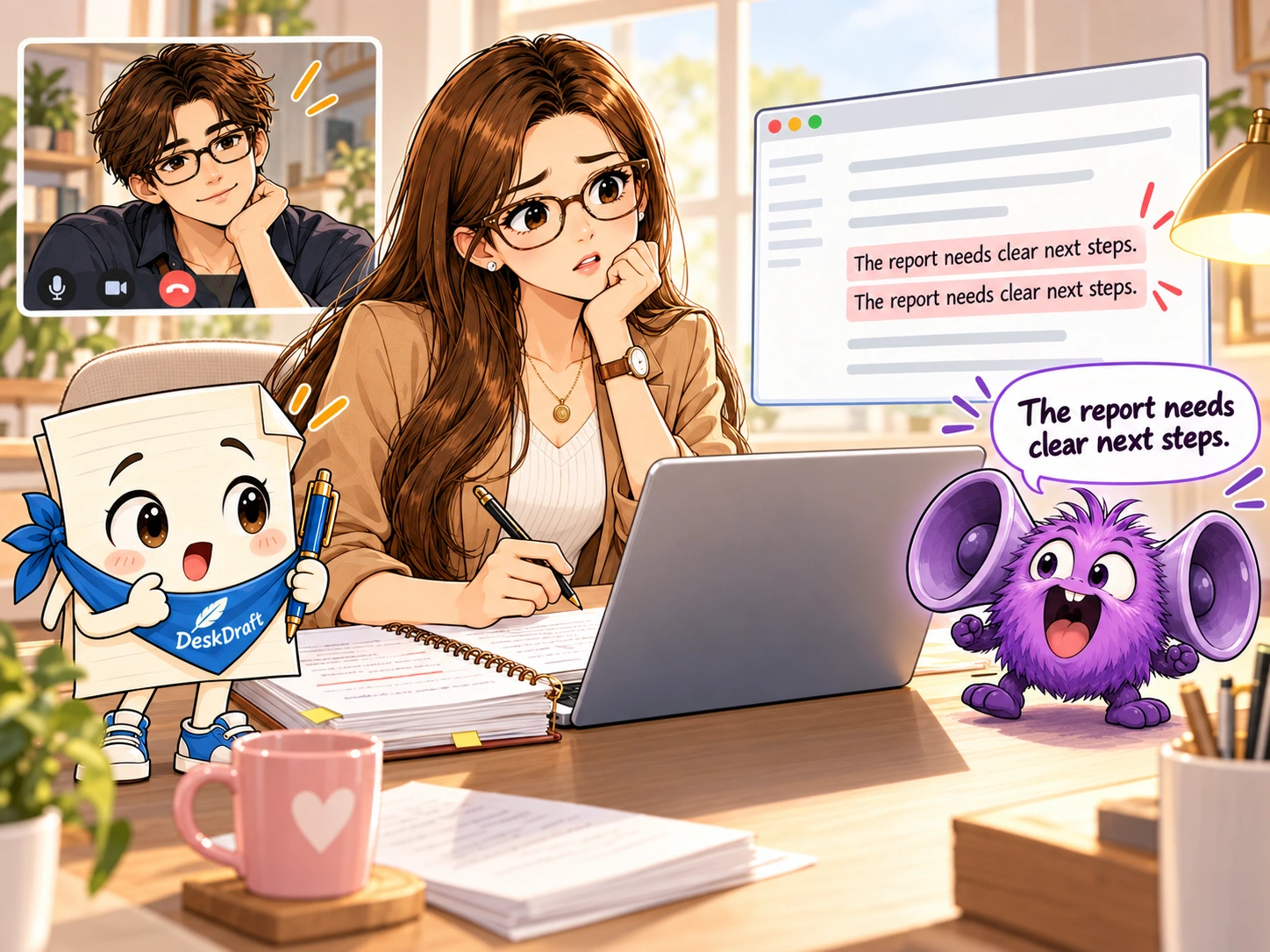
Same basic idea.
Patricia sighed.
“I thought varying the wording meant it was not repetition.”
Draft tilted his head.
“Readers notice ideas, not just words.”
Patricia deleted the third paragraph.
Then restored it.
Then shortened it.
Then moved it.
Nothing felt right.

The Client Review
The article grew to almost two thousand words.
Patricia sent an early draft to Reed, who was reviewing it for the client.
His response arrived the next morning.
The examples are useful and the structure is easy to follow.
Patricia smiled.
Then she read the next sentence.
But several sections repeat the same point. The article feels longer than it needs to be.
Patricia’s smile disappeared.
Draft looked over her shoulder.
“That is specific.”
“I know.”
She opened Reed’s comments.
Beside one paragraph, he had written:
You already explained this above.
Beside another:
Same point as Section 2?
And farther down:
Is this adding something new?
Patricia leaned back.
“That last one feels personal.”
Draft smiled.
“It is a good question.”
Patricia crossed her arms.
“I am emphasizing the important ideas.”
“Maybe.”
“Clear communication is important.”
“You have made that very clear.”
Patricia looked at him.
“That sounded sarcastic.”
“I learned from Paige.”
She started reviewing the article.
Reed was right.
The problem was not one repeated sentence.
It was an entire pattern.
Patricia introduced an idea.
Then explained it.
Then explained it again from a slightly different angle.
Then added an example that proved the same thing she had already proved twice.
She had not been writing badly.
She had been refusing to leave.
Something tiny popped out from behind the word clarity.
Patricia leaned toward the screen.
A round little creature peeked over the sentence.
It had a wide grin and carried a miniature copy machine strapped to its back.
It pressed a button.
A second copy of the sentence appeared.
Patricia stared.
“No.”
The creature pressed the button again.
A third copy appeared.
Draft covered his face.
“Repeater.”

Repeater
Repeater loved important ideas.
The more important the idea, the more Repeater wanted to say it again.
And again.
And once more, just in case.
It wore a belt filled with tiny stamps:
AGAIN
ONE MORE TIME
JUST TO BE CLEAR
AS MENTIONED EARLIER
IN OTHER WORDS
Repeater bounced across Patricia’s article.
Whenever it found a sentence it liked, it stamped it.
The sentence did not always duplicate exactly.
Sometimes it came back wearing different vocabulary.
Sometimes it appeared in another paragraph.
Sometimes it disguised itself as a conclusion.
Patricia grabbed the creature.
“You are making my article too long.”
Repeater pointed to one paragraph.
“But important!”
Patricia blinked.
It had copied Draft’s voice.
Draft frowned.
“Do not encourage it.”
Repeater jumped onto another paragraph.
“Clear communication matters!”
It copied the idea.
“Clear instructions reduce confusion!”
Another copy.
“Good communication saves time!”
Another.
Patricia groaned.
“I see it now.”
The Repetition Check
Patricia opened DeskDraft’s Repetition / Style Check.
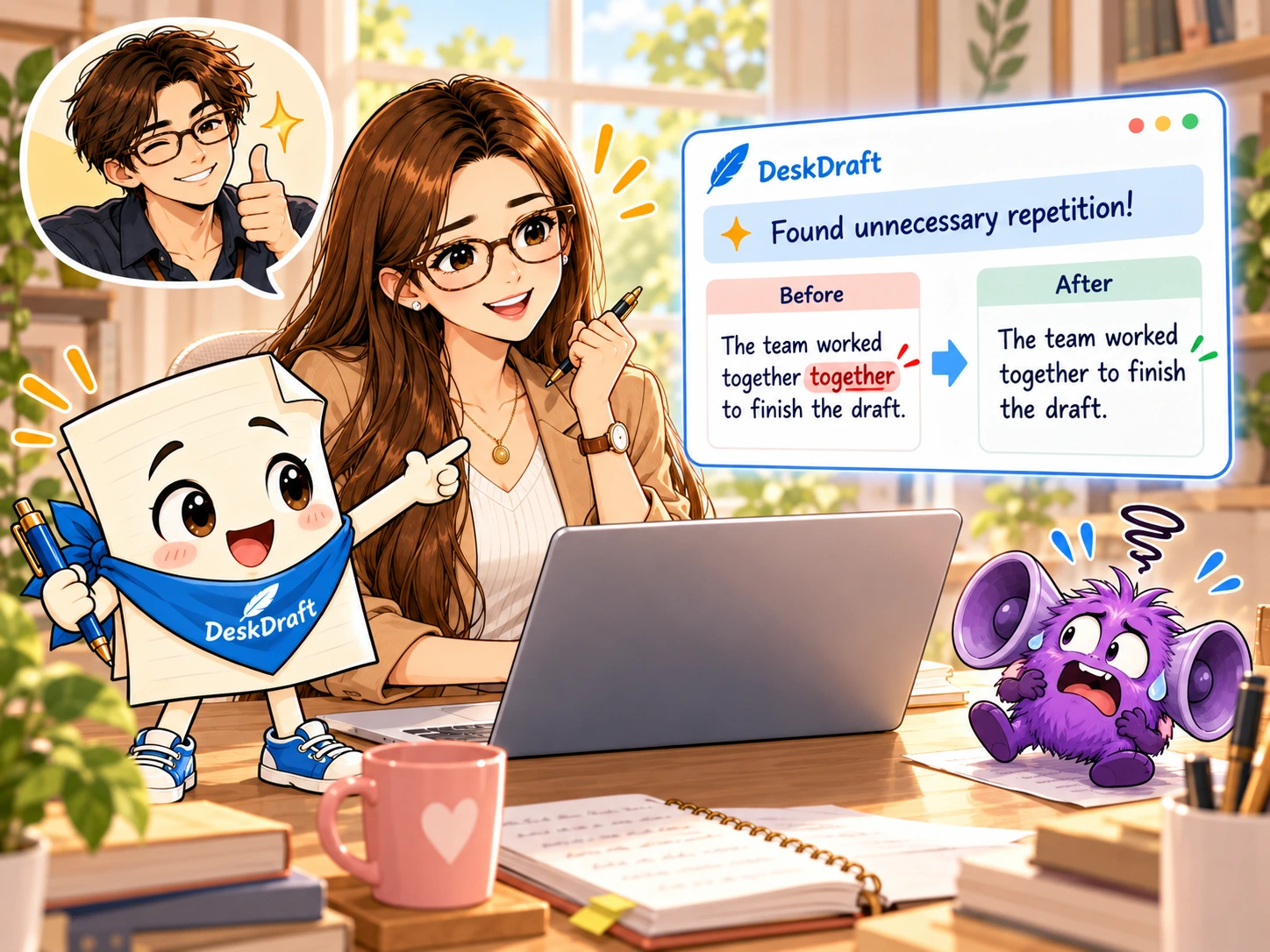
The article filled with subtle highlights.
Some repeated words were harmless.
Remote team appeared several times because that was the topic.
Communication appeared frequently because replacing it with random synonyms would only make the article strange.
But other highlights connected entire ideas.
DeskDraft grouped three paragraphs.
Possible repeated idea:
Unclear instructions cause confusion and wasted time.
Patricia clicked the first paragraph.
Then the second.
Then the third.
The wording was different.
The point was not.
Another group appeared.
Possible repeated idea:
Written instructions are important because remote workers may not receive immediate answers.
Patricia stared.
“I said this four times?”
Draft counted.
“Five, if we include the conclusion.”
Repeater cheered.
Patricia pointed at it.
“That is not an achievement.”
She began cutting.
At first, deleting sentences felt wrong.
Each sentence was fine by itself.
That was the problem.
There was no obviously bad sentence to remove.
She had to ask a different question.
What does this paragraph add?
The first paragraph introduced the problem.
Keep.
The second gave an example from a remote design team.
Keep.
The third repeated the explanation with no new information.
Delete.
The fourth added a practical method for writing clearer instructions.
Keep.
Patricia nodded.
“This is easier when I think about the job of each paragraph.”
Draft smiled.
“Exactly.”
Not All Repetition Is Bad
Patricia became aggressive.
She deleted every repeated phrase she could find.
A few minutes later, Draft stopped her.
“Read this section.”
Patricia read it aloud.
The section introduced three rules:
Say what needs to happen.
Say who is responsible.
Say when it is due.
Later, the conclusion repeated:
What needs to happen. Who owns it. When it is due.
Patricia reached for Delete.
Draft blocked the key.
“That repetition works.”

Patricia frowned.
“But I already said it.”
“Yes.”
“So why keep it?”
“Because here it helps the reader remember the framework.”
Patricia paused.
That was different.
Earlier repetition had happened because she did not trust the reader to understand her first explanation.
This repetition had a purpose.
It created a pattern.
It reminded the reader of something useful.
Patricia leaned back.
“So the problem is not repetition itself.”
“No.”
“It is repetition without a new job.”
Draft nodded.
Repeater looked confused.
Patricia smiled at the creature.
“You can repeat something if you have a reason.”
Repeater immediately copied the sentence.
“You can repeat something if you have a reason!”
Draft sighed.
“Perhaps do not explain nuance to it.”
Draftspace
The room disappeared.
Patricia and Draft stood inside a long corridor made from pages.
Each door was labeled with one section of the article.
Repeater ran ahead.
It opened the first door.
Inside was a large glowing idea:
CLEAR COMMUNICATION REDUCES CONFUSION.
Repeater grabbed the idea, copied it, and carried the duplicate into the next room.
Then another.
Then another.
Soon the same glowing idea filled half the corridor.
Patricia walked from room to room.
“No wonder it feels long.”
Draft pointed toward the duplicates.
“If each section adds something new, the article moves forward.”
The first room changed.
Problem:
Unclear instructions cause mistakes.
The second:
Example:
A designer completes the wrong version because the request was vague.
The third:
Solution:
State the task, owner, and deadline.
The fourth:
Result:
Fewer follow-up messages and less rework.
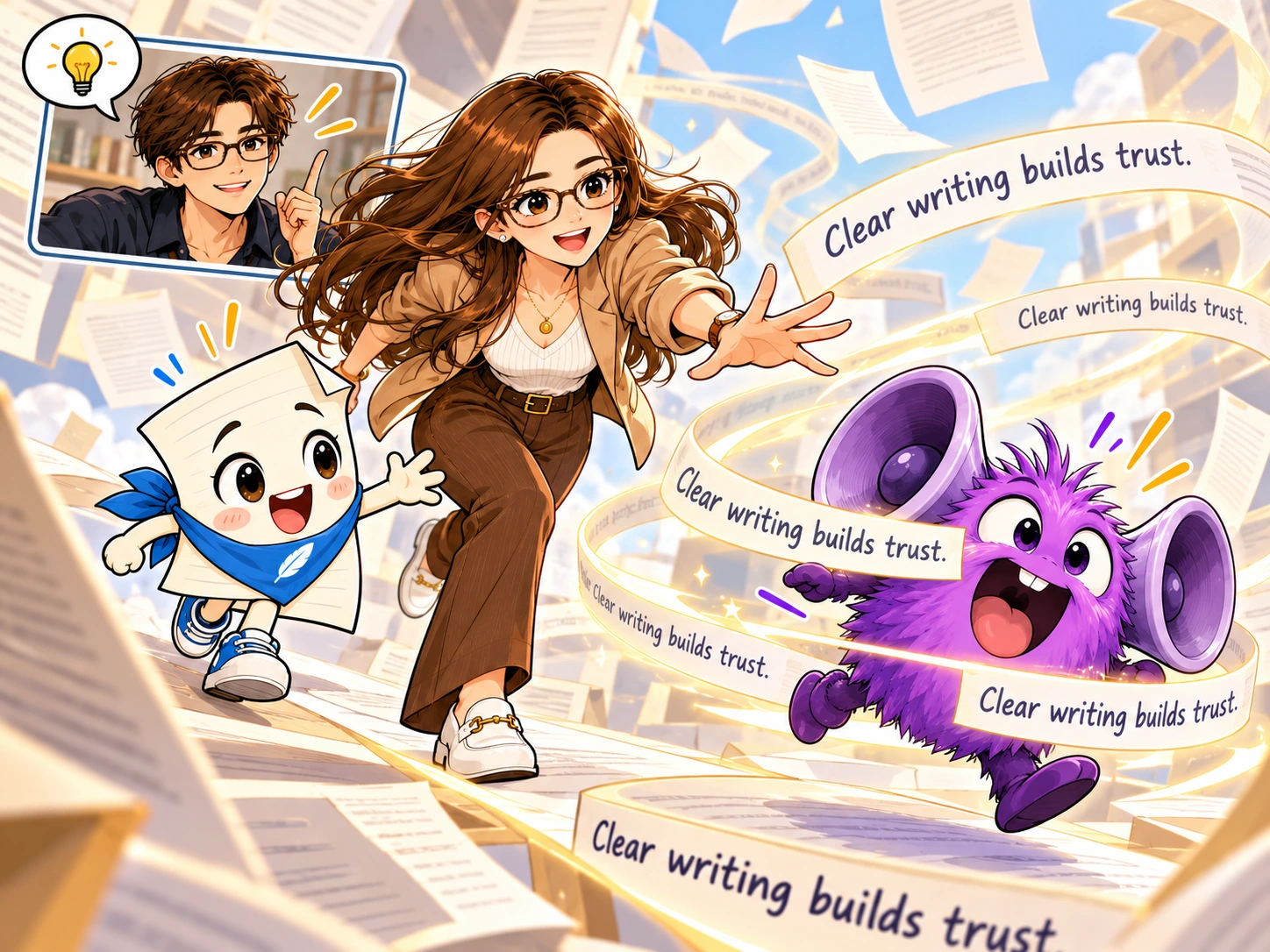
Patricia smiled.
“Same topic. Different job.”
“Yes.”
The corridor shortened.
It did not feel empty.
It felt faster.
Repeater picked up the original glowing idea again.
Patricia took it gently from its hands.
“We only need this once here.”
Repeater looked devastated.
Then Patricia placed a smaller copy in the final room.
“Here, it becomes a reminder.”
Repeater brightened.
Draft looked impressed.
“You negotiated with a Draftling.”
“I am developing management skills.”
Draft laughed.
A Stronger Draft
Back at her desk, Patricia rebuilt the article.
She combined two paragraphs.
Deleted another.
Moved an example closer to the idea it supported.
Turned a repeated explanation into a practical checklist.
Shortened the introduction.
The article dropped from nearly two thousand words to about fifteen hundred.
Patricia stared at the word count.
“I deleted almost five hundred words.”
Draft looked at her.
“Did you lose anything important?”
Patricia read the article again.
No.
In fact, the important ideas were easier to see now.
The article no longer sounded as if Patricia were circling the same point, afraid to move on.
It moved.
Problem.
Example.
Explanation.
Solution.
Next idea.
Patricia sent the new version to Reed.
His reply came later that afternoon.
Much stronger. The article feels more confident now. Each section earns its place.

Patricia stopped at one phrase.
More confident.
That surprised her.
She had assumed adding more explanation made writing safer.
Instead, removing unnecessary repetition made the writing sound more certain.
Draft read the comment.
“You trusted the reader.”
Patricia nodded.
“And maybe myself.”
The Notebook
Patricia opened her Draftling notebook.
Repeater immediately climbed onto the page.
She wrote:
Draftling #005 - Repeater
Represents: Unnecessary repetition of words, sentences, or ideas.
Weakness: Ask what the repeated line adds. Keep repetition that has a purpose. Remove repetition that only says the same thing again.
DeskDraft Feature: Repetition / Style Check.
Repeater stamped AGAIN beside the note.
Patricia crossed it out.
The creature stamped AGAIN below that.
Patricia crossed it out again.
Draft started laughing.
Patricia tried to look serious.
Then she laughed too.
She added one final lesson:
Every paragraph should move the reader somewhere.
Below it:
Repeat when it helps the reader remember.
Cut when it only makes the reader wait.
Reed’s final message remained open on her laptop.
Each section earns its place.
Patricia liked that sentence.
Not only for the article.
For her work in general.
She was beginning to understand that better writing was not always about adding more.
Sometimes it was knowing when the point had already been made.
Repeater pressed its button.
A tiny copy of the lesson appeared.
Patricia looked at it.
Repeater slowly lowered the copy machine.
“Thank you,” Patricia said.
The creature nodded.
For once, it did not repeat itself.